“The forces of evolution act upon a man’s tools as well as upon man himself “
A.C. Littleton (1926, P.12)
Welcome to the tale of an Accounting Academic who transformed into an Accounting Technologist, Accounting Historian, Accounting Anthropologist and a pretty decent knitter…
Dr. Lesley Niezynski is an early career interdisciplinary accounting researcher specialising in accounting technology, history and humanity. Lesley’s research centres on the interconnectivity between accounting, humanity, and technology.
Lesley has recently completed her PhD, a project centred upon the interconnectivity between humanity, accounting and technology through a study of Maritime Technology, Accounting and Merchants in Early Modern England.
Prior to accounting, Lesley’s interest in boundary blurring, human-centric research formed in her studies in Architecture, with studies in the interconnectivity of Architecture, Fashion, and Health.
What is she up to right at this very moment? Find out here.
I’m now on Substack! Find me at https://accountingforhumanity.substack.com/
-
PhD and Me – Mental Health
Writing this post a day early (I begin teaching again tomorrow) has somewhat thrown off my thought process in deciding what to write about this week. Thus, considering I mentioned it in my previous post, perhaps now is a good time to introduce the topic of mental health into my PhD reflections. Like many areas of life, mental health can often get left behind when discussing the PhD experience but it is most definitely something that should always be considered, and openly discussed, in a PhD journey.
Disclaimer: Below is a reflection of my own, personal mental health experience, situation and journey. Mental health is as individual as we are and thus, please remember not to ‘rate’ or compare your experience to mine and judge yourself (or me) for it. What is a struggle for me, may not be a struggle for you and similarly, what is a struggle for you, may not be a struggle for me. If you take anything from this, please let it be that you are never alone and always seek help when you are struggling. You have value, you are worthwhile, and your story and experience is worth hearing/sharing.
Me and my mind (for context/explanation of my own thoughts/responses in the below sections)
To put my thoughts and experiences on mental health into context, I live with anxiety and depression. My anxiety holds dominance over the depression, but there are times when depression rears its motivation-draining head, but largely anxiety is the demon I deal with on a daily basis. I have spent most of my life with anxiety, it was a presence and mindset that I believed that I could ignore however, at the age of 32, the loosely constructed façade failed and I had breakdown. After experiencing an extreme anxiety attack during an exam over a simple computer issue, I finally realised that I could not carry on like this, ignoring the anxiety was not working and it would not go away if I pretended that it was not there. In addition, I had just begun my masters and I knew that I would not survive/complete the course if I did not seek help.
After a trip to the doctors and guidance from my employer at the time, I would find myself spending the next few years in weekly counselling and later therapy upon which I have made progress I did not think possible. I gained a confidence in my ability that I have never before possessed, and I can (most of the time) ‘talk down’ anxiety attacks. This progress has, for the most part, allowed me to become a reasonably functional/happy human however, I am not without mental struggles entirely; I am very much an ongoing work in progress.So, what exactly goes on in my mind? My issues centre primarily on social anxiety and self-worth. In short, my low self-worth causes me to place a high dependence on the opinion of others, and subsequently creates an extreme fear of judgement. To add further difficulty from a PhD perspective, more than any other area, I rate academia exceptionally highly in assessing my own self-worth and thus, it is characteristic for me to place unreasonably high and difficult standards upon myself in this area. This complicated love/hate relationship spawned in my early teenage years. I did not fit in at highschool, I was frequently bullied, so much so that I felt that I had nothing worthwhile to offer the world; if people did not accept me, I had no place in society. However, another facet of my personality is a fear of confrontation and as such my desired response to bullying was to escape and thus, at some point I began to view getting good grades as my way of escaping my tormentors. I held onto the reality that one day our class would be separated based on academic ability and, if my grades continued, at that moment, I would be free of those who chose their ‘entertainment’ (at my expense) over study. In addition, I was ‘good’ at learning (I like collecting knowledge) and I often obtained high grades. Emotionally, I felt a great comfort in the social acceptance that I gained from excelling, the recognition of achievement felt like a validation of my existence, I could add something to the world. This sadly would also result in my connecting all of the wrong dots so to speak. I did not see that I had/have worth no matter what instead, I believed that when I was achieving, I was proving my worth and justifying my existence to the world, unaware that I had nothing to prove, I have as much right as anyone else to be here.
This is clearly a very brief introduction to my story however, from this I can surmise that I am someone who both holds a strong confidence in my academic ability (I know I am very intelligent and have a lot of potential) but also struggles to forge a path based purely on my opinion/merit. This comes from a mix of having great respect for the people that I work with while also having an anxious insecurity that leads me to feel that I cannot proceed without their reassurance. While I acknowledge my ability fully, I seem to lack the belief that I can lead it down the correct path.
Thus, in undertaking a PhD, there will be/are some obvious issues that can occur for me personally. however, today I chose to ponder a few of the most common across the PhD experience. I do not doubt that there are countless other circumstances that we can/have encounter(ed) but let us start here…
PhD’s are stressful.
Yes. Yes they are.
PhD’s are a significant undertaking that involve copious amounts of study, research, work, adaptation, and perseverance (and presumably thick skin which I am sure I will fully learn soon enough). At no point will it be ‘easy’ (and it is unlikely that anyone would ever tell you that) but note, that does not mean that it will be a negative experience. Hard work can (dare I say) be positive if you truly enjoy what you are doing. Do not mistake this for toxic positivity, I still get very anxious and stressed about how much I still must do, and still hold onto that negative concept of ‘will it be right/good enough’. However, even amidst this worry, I see how much I enjoy reading, researching, and imagining what discoveries my thesis might bring. I am passionate about history and to be able to spend (hopefully) 4 years dedicated to it is quite wonderful. Is the concept of producing a ~100,000-word thesis horribly daunting and stressful? Absolutely, but I cannot think about this, if I give my anxiety even 1mm, it will consume every piece of available space in my mind, filling it with every horrific ‘what if?’ scenario available. Instead, I choose to forget that there are 4 years (or 2 remaining now) ahead. Instead, I think about today, maybe tomorrow, and even sometimes the end of the week; but no further (one of the best things I learned from my counsellor). Asking what I can do today, is far more productive than hypothetically planning every detail of the next 2 years of my life.Imposter Syndrome: You are more deserving than you think
This is a common feeling for PhD students although, I am very fortunate that I have largely avoided this feeling. I understand the concept, we feel that to be in this position we should be someone of higher significance. A PhD is an important undertaking, it thus ought to be a role for a very smart and capable person. This, however, is not my complete view of the role of the PhD. Yes, it is important and you do have to be a very dedicated and adaptable person (‘smart’ I feel is perhaps too vague a term as intelligence is present in everyone so, I would argue that we are all ‘smart’ enough to do a PhD, it is more a question of if we would want to do it or not and do we have the perseverance for it) but it is the beginning point of the academic career. It is the opportunity to ‘test the water’ and find out if academia/research is everything that you thought it was. If it is then you will complete your PhD and move on to bigger and better things (I have an ever-growing list of ‘future research’ topics) and, if it is not quite what you hoped it would be, you will still move on to bigger and better things regardless of whether that includes a complete PhD or not. No one (unless they already have a prior PhD) goes into a PhD with the knowledge of everything that must be done and how exactly it should be done. You ‘learn on the job’. As I frequently state, for me, the PhD is a journey, you are expected to figure it out as you go. The only thing that would make me feel like an imposter would be if I were doing a PhD that I truly did not want to do.
Am I doing it right or, am I good enough to do this?
This I admit is quite similar to Impostor syndrome, but I feel that there are differences that merit a separate consideration. Academia is most certainly where I fit in, I do not experience a 100% ‘I do not belong here’ doubt but, there is an always creeping thought of ‘what if I end up disappointing everyone?’ This notion plays right into my social anxiety and crippling fear of judgement and as mentioned, my (flawed) solution to these feelings is to set unreasonably high academic standards upon myself; so that I may find my worth in my magnificent achievements at the end. The true issue here is not about my not being good enough however, it is the reality that I value the opinions of others above my own when it comes to my own existence. This was (and still is) the hardest notion to address in counselling/therapy. While not producing ‘the best thesis the world has ever seen’ would have little to no effect on anyone (even upon me), my mind cannot detach from the concept that I will have ‘let someone down’ (even if I have not). The worry comes not from how my own life would be affected but how it would affect other people thus, I have inadvertently told myself that my feelings do not matter (which is absolutely not true, it should only be my feelings that matter when we are considering something that affects my life alone).
I admit even after counselling and therapy, I am not fully past this struggle. I have allowed my self to believe that I am good enough to do a PhD but I am still somewhat bothered by the concept of ‘am I doing it right?’ This I feel comes down to not really knowing what I PhD is (as mentioned in my last post and above), with each day however, I do learn a little more and hopefully in time I will fully realise that I am the one becoming an expert in my chosen field and thus, with each day I actually become the one who can say what is/is not ‘good enough’.
I can’t do this
This is a thought we will most likely all have at some point. As noted, going in most of us have no idea what we are signing up for and it can (and does) get horribly overwhelming at times. What is important here is to acknowledge that you are struggling and to talk to someone (such as your supervisor or health professional) for myself, in the midst of a mental health crisis, it can be difficult to maintain perspective, my anxiety can and does put my circumstances far out of proportion and thus, talking to someone else can help ‘defuse’ me (note: a no point should you let anyone patronise you in this situation, the idea is to guide you to calmer state of mind and allow you to analyse your situation with more clarity, not to tell you that you are ‘overreacting’ or ‘being silly’). For some, we will find that we are panicked because we are truly passionate about our PhD and want to do the very best possible (which like myself, leads to producing unreasonable expectations but remembering the passion is one important step in reminding yourself that you are in the right place) but also, for some it will be the sign that this is not the path that you want to be on. The importance here is to know which one of these is true for you, you do not want to make a rushed decision that you will regret.
One example in my own experience was in my Post Grad year in architecture. I had made it through the gruelling, mentally draining (and in truth, damaging) 5+ years and gotten my PG Diploma however, I had the option to carry on for a few extra months to transform the PG Dip into a masters degree. Initially I signed up, after all what is a few extra months on 5+ years? However, the more I thought about it, I realised that I could not do it. My mental health and confidence had been destroyed and I could not bear the thought of going through another day of architecture let alone several months. I thought through what each decision would mean for me (it was one of the rare occasions where I thought about myself) and I concluded that I had to walk away from architecture. Truthfully, I only realised in doing my accounting masters 10 years later that those few months would have been a dissertation (the one thing I am good at/enjoy) which is unfortunate but do I regret the decision? No. Not even one little bit. For the sake of my health, I had to walk away and in time (albeit a long time) I thankfully found my way to where I am now.
Final thoughts (for now)
While I wish it were not the case, PhDs and mental health are inextricably linked for many of us. For some it may be minor and for others it may be all encompassing. As noted, our experiences are unique and while there is no fix-all solution, there will be a solution. For myself, when I feel the anxiety/doubt/depression rising; I remember the details from above; Focus on today, remember that I deserve this opportunity, that I am doing this for me, that I want this and thus, I can do this, and finally that I am not doing this alone, help is there for me to ask for (whether that be for ideas, solutions, or simply someone who can listen to you). As always there are small things we can do to give our minds a chance to slow down; hobbies, getting outside (not always possible in Scottish weather but a truly helpful one for me when I can), grounding exercises, and focusing on breathing, but again, never hesitate to reach out to someone, even though we may not believe it all (or any of) the time, we are worthwhile
As a point of note, if you are Edinburgh based and counselling is financially unavailable to you (£40-60 per hour was not something I could afford no matter how much I needed it), I cannot recommend PF Counselling enough. I owe all of my progress to the help I received there. See https://pfcounselling.org.uk/ for more information. (Also this service was recommended to me by my employer so definitely do not hesitate to reach out to your university/employer mental health services if they have them)
-
The Legend of PhD: The Focusing of Research Questions…
(Disclaimer: Here you will learn that I am a dedicated fan of Nintendo’s ‘Legend of Zelda’ series)
After almost 2 years, this week I finally hit the milestone that has haunted me from day 1. I defined my research questions.
Of all the mental struggles that a PhD can bring (a topic for future discussion rest assured), the defining of a research question is the one that has made me feel the most vulnerable in these first 2 years of study (note: I have been a part time student for the first two years). It was the factor that constantly reminded me how unfamiliar I am with undertaking a PhD, I had never done this before, how am I to know what is the ‘right’ question and what is ‘wrong’ question? I know this line of ‘right and wrong’ thought is not helpful, unfortunately my thinking can be quite ‘black and white’ at times; my anxiety continually fights to make me forget that those tantalising shades of grey that bring reason to thoughts and ideas exist.
I always had a base concept of what I want this PhD thesis to be, I want to show the world that technology is not as terrifying as we often see the media portray (another note: the film M3gan is a fascinating interpretation of our relationship with technology and a fantastic example of how the media vilifies AI/Robotics). However, this concept alone was not enough, I need to have a specific focus that will bring this concept to life thus, I need research questions.
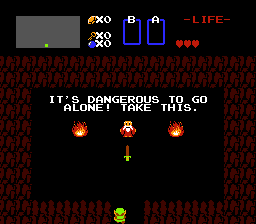
The Legend of Zelda. Image sourced from https://en.wikipedia.org/wiki/It%27s_dangerous_to_go_alone! As mentioned, I have never done a PhD before and as such, I have no idea of what this journey entails nor do I know how I ‘make’ a research question. To add further complication, unlike my crafting pursuits, YouTube would not provide a tutorial to get me through this time. I had read countless guides and ‘how-to’s’ on how to refine a research question, but it was not producing a viable result, the questions were either too vague or so expansive that I could never answer it in one thesis. As a result of my confusion and frustration, I would spend my time punishing myself for not having a ‘good’ question, a trial so prolific that it was causing me to question if I even had a worthwhile contribution to make in this research field or if I were merely clutching at straws in a bid to write extensively about ‘something I like’.
To attempt to aid my efforts to see this quest to a successful end, I opted to just keep reading and writing, I felt that I could not do anything else so I may as well carry on with the one thing I could do. With every paper read, I would add a paragraph to my summary notes; what was this paper saying, what was it not saying? What was happening ‘between the lines’? Every summary became a miniaturised literature review in itself. As set forth down this path, my knowledge grew with each cautious step until I would eventually stumble across my salvation, courtesy of my supervisors (this tale also demonstrates one of an infinite number of reasons why supervisors are pivotal). In my reading, writing and pondering (I do a lot of ‘pondering’ the only positive attribute that my anxiety brings with it) I discovered two interesting theories that offered explanation to the findings that I was reading in the literature and thus, I began to write about these theories too, summarising how they could relate to accounting. Upon meeting my supervisors in the latter half of 2022, their enthusiasm appeared to ignite anew at the sight of these theoretical concepts. There was something exciting in this idea, it was the missing link, the (almost) final piece that explained the puzzle that was my literature review!
With these theories underpinning the literature, we could finally see a research question forming; it was neither complete nor perfect but at last, my concept could be aligned to a specific area of research in the field of accounting and technology. That was both the relief and motivation I need to forge ahead on PhD quest. I would thus spend the following 4-5 months once more exploring the literature, but now also exploring how this theoretical framework exposed further findings within it.
From this process I was led to another important discover only 2 weeks ago, I could not do this. Or, more specifically, I could not all of this. I had compiled a group of questions that covered the entire known history of our existence, cramming thousands of years into 3 research questions. It was not feasible and, since I had spent the prior 4+ months on the Middle-Ages alone, I knew I could never explore all the eras I wanted to. Disappointed as I was, this again was the plot twist that diverted my quest to the next level; I could use this realisation to further define my research questions by focusing on one specific era. With this I considered all the era featured in all of the content that I had read, the Middle-Ages, and I could see a gap in the narrative, the hidden gem waiting to be discovered. Thus, I boldly scrapped 2 of my 3 prior research questions and adapted the remaining 1. Now I held a question with purpose, with focus, with potential.
Ironically on my next meeting with my supervisor (not but a few days ago from posting this), my new research question was now too focused, so focused in fact, that I was answering my question within my question. Again, this was a reminder of how little I know the PhD process, but it is also highlighted the progress that I have made. After some small adaptations, I am now in possession of two research questions. Again, they are neither complete nor perfect but, unlike before, they can direct my data collection and analysis. In time they will evolve once more however, now I am fully equipped to carry on in my journey. With my ‘sword and shield’ I can take on the next set of challenges that my PhD will bring.
So it would seem the message here is that the PhD is certainly an adventure out into the unknown. Like any good adventure, we’ll get stuck or lost along the way but, if we stay true to the course we’ll complete the game.
In short, when it comes to a PhD, do I know what I am doing? Absolutely not.
But I do know that life is like a good game of Zelda; it’s is an adventure, and it takes time and experience to gather all the necessary equipment, knowledge and experience to make it to the end…
-
Taking Breaks and Taking Stock: Moving into 2023
I had fully intended to create at least one more post before 2022 ended however (and perhaps unsurprisingly knowing my habits with blogs), life had other plans meaning that we are now in the first post of 2023. This is not to say that anything catastrophic and/or life changing threw itself before me as 2022 reached its grand finale, instead it was a (thankfully) mundane situation, merely everyday life reminding me that sometimes it is good to simply stop and take a break.
A PhD is an all consuming undertaking, no matter what I am doing, it is always there in my mind. Sometimes it is quiet, other times it chatters away in the background to some other activity (usually cycling), and then there are times when it screams to be heard. While having a topic I am exceptionally interested in taking up residence in my head is a more than welcome change from the anxiety that held that coveted position previously, sometimes I need to be able to step away from my thesis to keep it interesting, as too much of a good thing can destroy what made it special in the first place.
Taking a break is far more progressive (in the sense of making progress in your work) than one may initially think. Yes, I too live with the constant fear that if I stop I may stall (or worse, stop) the motivation that has kept my thesis going, but this kind of journey is most definitely equitable to exercise, if you refuse to stop every now and then, eventually your body will stop for you. Taking that brief pause to take a breath and figure out where you are is pivotal to moving forward. When I’m cycling, even a 1 minute pause to check the time or fix a face mask gives me a renewed vigour, a drive to keep going as I utilise a little burst of new energy. My brain is exactly the same, when I write I have to stop and walk away as, on my return I can truly see where I am and what I’ve created (after all, a thesis requires just as much creative endeavour and vision as any art work).
So, what did I do instead of updating this blog in the final weeks of 2022?
I decorated. After much procrastination I finally embarked on my mission to create my “Victorian Craft Cave”. Over the previous 2 years I have been gripped by the vision of turning my workspace into something truly wonderful, its white walls may have indeed been a blank canvas, but for me I need to be surrounded by wonder and curiosity to feel truly inspired. History has always fascinated me (as previous posts may have implied). Objects, images, and spaces of the past evoke such magnificent trails of thought and wonder (admittedly not all are good, it is important to address and acknowledge the darkness in our history but, when embodying history in the modern world, I wholeheartedly agree with the “Vintage style, not vintage values” approach coined by Dandy Wellington) that I find myself equal parts inspired and mesmerised by and thus, I’ve always craved a space such as this to inspire creativity and escape from the white walls and sometime chaos of modernity.
Although this decision left me continually covered in paint for almost 2 weeks and confronted by the reality that painting ceilings is more exhausting than I anticipated, this sharp turn away from my PhD was far more needed than I realised. I have returned to work this week, invigorated and motivated to get this thesis going, in following my interior design dreams I have embodied a larger motivation to keep creating in other areas of life, a continuation of that initial desire of creating something truly wonderful if you will.
There is much to be done in 2023, I have a literature review, theoretical framework and methodology draft to create and then, there is finally getting into the actual data collection to consider. With an annual review due by June, the writing part of this task will not be easy, but I will take this discovery of taking creative breaks forward (after all the Victorian Craft Cave is not yet complete).
Unusually for me, the first task undertaken this year is that I have made a plan (generally this is a feature that lives in my mind alone) and to see it written down puts it in perspective and (rather pleasantly) takes away the dread I felt while this plan lived in my mind, constantly mutating and merging with my anxiety to produce a distorted view of my reality.
Equally, putting to words on here what I my PhD plans are helps confirm these intentions. They are now committed to the written word and I am accountable to see them through. Although I do not say that I am accountable to the online world in undertaking this task, an important lesson that I have learned that this is my journey, and mine alone, and I can sit down, paint a ceiling and take a break whenever I want…
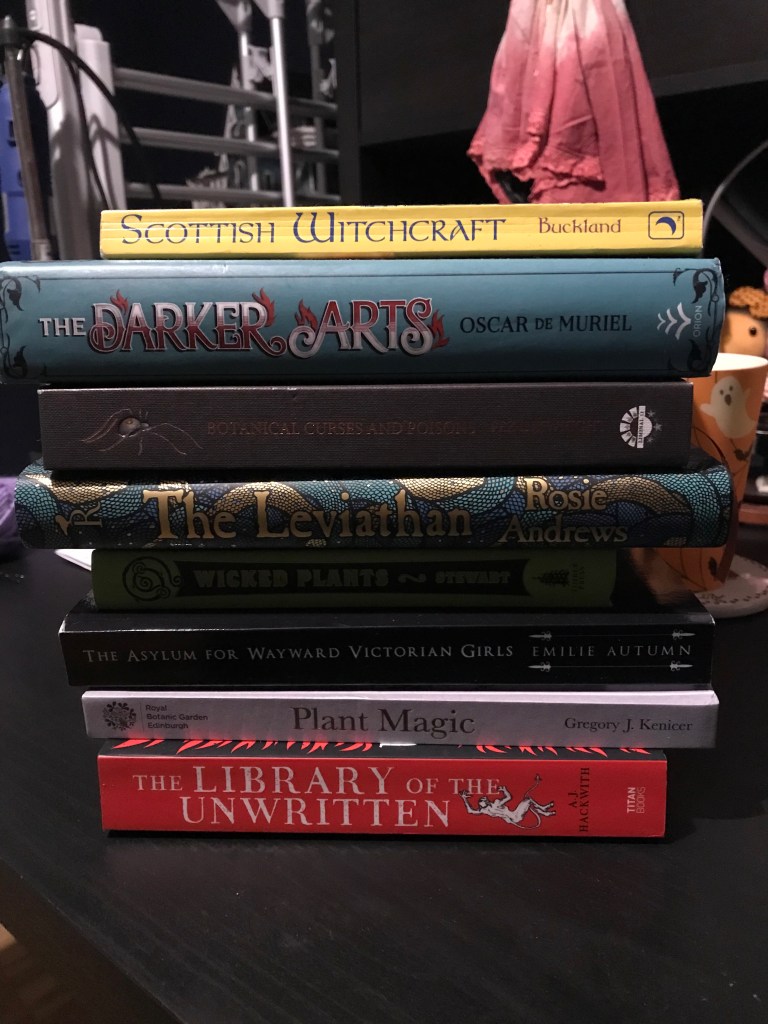
On a side note: To follow up from the previous post, here’s 2023’s reading resolution list. I am determined to become a capable/less nervous forager one day thus, I hope to learn more about the good, the bad and the ugly of the botanical sort.
-
2022: The lessons I learned from a pile of books
This is not likely to be my final post of the year however, pre-Christmas felt like a natural point for partaking in some good old reflection to give some direction for my 2023 goals.
2022 in 8 Books
Resolutions and reflections are processes that have been a near constant part of my mental space throughout my life although, it has admittedly not been a space that has seen much success. In recent years however, I seem to have found myself able to learn some valuable lessons from these processes and even celebrate some small successes in my goal setting.
In 2022 this all derived from a simple New Year’s Resolution. In my ambition to ‘read more books’, I have learned some invaluable lessons that I have been able to successfully transfer into my PhD studies/research and witness some very welcome progress.
So, what did I learn from reading more in 2022?
I have too many unread books…
The purpose of the resolution was to get back into reading for leisure. In 2021 my reading rate was what could be described as ‘diabolically slow’ for someone in possession of a mountain of unread books. I have the problem of possessing more ‘unread’ than ‘read’ books, and this is something that I was/am absolute in my determination to amend.
While having an undoubtedly huge task ahead (as mentioned, I possess many, many unread books), I entered this resolution not with the priority to read until my eyes bled, but with the want to experience a ‘win’ in resolution making. I was not prepared to see this go the way of many a New Year’s Resolutions i.e., admitting defeat by February, I wanted the joy of feeling accomplished, I wanted the ‘win’. I am unsure of what prompted this approach but, it was most definitely an unknown experience for me. I am known for pushing myself too far, burning out, and deriding myself over having burned out before meeting my target. Yet, here, I was placing myself and happiness first and was subsequently pleasantly surprised to feel that, even before setting the target, I was already feeling good about the journey to meeting this goal.
Lesson 1: It is about the winning, not taking part
Hear me out, this is not about throwing caution to the wind and doing whatever it takes to ‘one-up’ competitors to win recognition; this is about positioning yourself in the right space to enjoy the experience that you are about to partake in. Thus, it is not strictly about ‘winning’ something in the sense of being 1st place or being ‘the best’, it is about going into something with the feeling that you have already achieved something incredible. It does lie close to the ‘Positive mental attitude’ cliché but, there is merit in embracing in the positivity that comes with acting like you have already won. It brings a level of confidence (note: confidence, not arrogance) that can birth and maintain the motivation needed to make the most of experiences and achieve your goals.
Bringing this into the PhD context, the lesson here for me is creating plans and targets that will bring enjoyment to my studies. The ‘real’ goal becomes about enjoying the journey; the ‘targets’ are just different waypoints, markers, and rewards to keep that enjoyment going. I used applied this lesson in 2022 to help me focus on my writing, at the beginning of the year I began worrying excessively about not knowing what direction my thesis should take, a worry that inevitably caused progress to stagnate. Changing my focus from thinking about the final ‘big’ goal (i.e., a completed PhD thesis) to writing about a subject that I enjoy, allowed me to work past those writing ‘blocks’ and now at the end of 2022 I have created a healthy supply of content that I can now use to create a literature review.
Lesson 2: Being ‘Realistic’ is not about Letting go of your dreams
To be ‘realistic’ is generally accompanied by negative connotations however, there is more to it than ‘letting go of your dreams’, ‘giving up’ or ‘settling for the next best thing’. Realism for me is the opposite of giving up, being ‘realistic’ is about finding the path that ensures that I will reach my goals, whether that involves taking obstacles ‘head on’, or finding another, longer way around.
It has taken many years of counselling and therapy but, I have finally learned how my mind works in the realm of achieving success. I know when I can push myself that little bit farther, when I am near my limit and, most importantly, when I have pushed too far. This for me is realism. It is about knowing oneself and understanding that one size most certainly does not fit all. My experience is not the same as yours, we may face similar challenges but, they will never be the same. In addressing ‘being realistic’ I have learned that, for the most part, I am a creative problem solver thus, I am more akin to the ‘find a way around’ an obstacle kind of individual.
In terms of applying this to my reading resolution, I wanted this reading quest to be more that a ‘one-off’. The aim was to install a new long-term habit and thus, I had to create a sustainable or ‘realistic’ goal. At first, I thought of reading one book per month but, considering I had read around 3 books in the entire 12 months previous; I suspected that this would be a step too far i.e., not realistic. Furthermore, in addition to considering the prior lesson about aiming to create ‘little wins’, reading is supposed to be fun and as such, pressurising it was not going to make it fun.
While the aim was to make this goal attainable I did, however, still have to make this a challenge. Thus, I needed a ‘balanced’ challenge; 75% effort, 100% of the time would be worth more to me in the end than a crazed 110% effort for 2 months followed by 10 months of burnout. With these parameters considered, I opted for 8 books in 12 months (1 around every 1.5 months). Additionally, I knew I had to vary my reading. I read fiction reasonably quickly, but non-fiction can take longer thus, to avoid frustration or stagnation, I would read 1 fiction followed by 1 non-fiction and carry on in that pattern.
This ‘realistic-inspired’ approach was exceptionally useful in my PhD research and writing as it allowed me to become more adaptable in my working methods. I learned to recognise days where my motivation was lower and thus, focus my goal for the day to suit my mood. My days now alternate between reading-focused, reading/summary writing and writing focused and I will dedicate an average of 1-3 hours on my thesis (1-2 hours being most common). With this variety and knowledge of my limitations, I have been able to maintain a productive pace throughout the entire year, something I was unable to do the previous year (2021 ended on 5 months of limited to no-PhD work and panic). As a result, being ‘realistic’ has brought me far closer to my PhD goals than my overly ambitious approach in 2021.
So, how did I do with my ‘Reading Resolution’?
Well as you may have guessed, the reason for writing this post was because I did complete my resolution (though I would have still written it if I had not succeeded as lessons still would have been learned). I read all 8 of my pre-selected books plus 3 more (and 2 additional theory books for my thesis). The motivation for this is not to brag, yes it feels good to be able to say what I have achieved and I am proud of myself but, my compulsion to share is based more on my feeling that what I have learned from this experience is extremely valuable.
I fully expected to encounter exceptional difficulty in attempting to read these books while also working on my thesis, reading all the thesis literature, and continuing in all the other activities that I enjoy. I thought incorporating reading into my routine would mean the loss of another activity (I think there is also a lesson here in identifying ‘idle’ time, as I may have more of it than I claim). I had hoped to reinstate a past hobby and create an ‘escape’ from my thesis (while I enjoy it, it is important to ‘pull’ my mind away from it sometimes) but I did not expect to emerge from this year having learned such valuable lessons in planning my PhD research. This simple resolution allowed me to reframe my mindset in approaching my work, the once impossibly high bar now rests a little lower, if not replaced entirely by a series of smaller hurdles, each one easily traversed in consistent little leaps and bounds.
Who knew you could learn so much from reading a book…
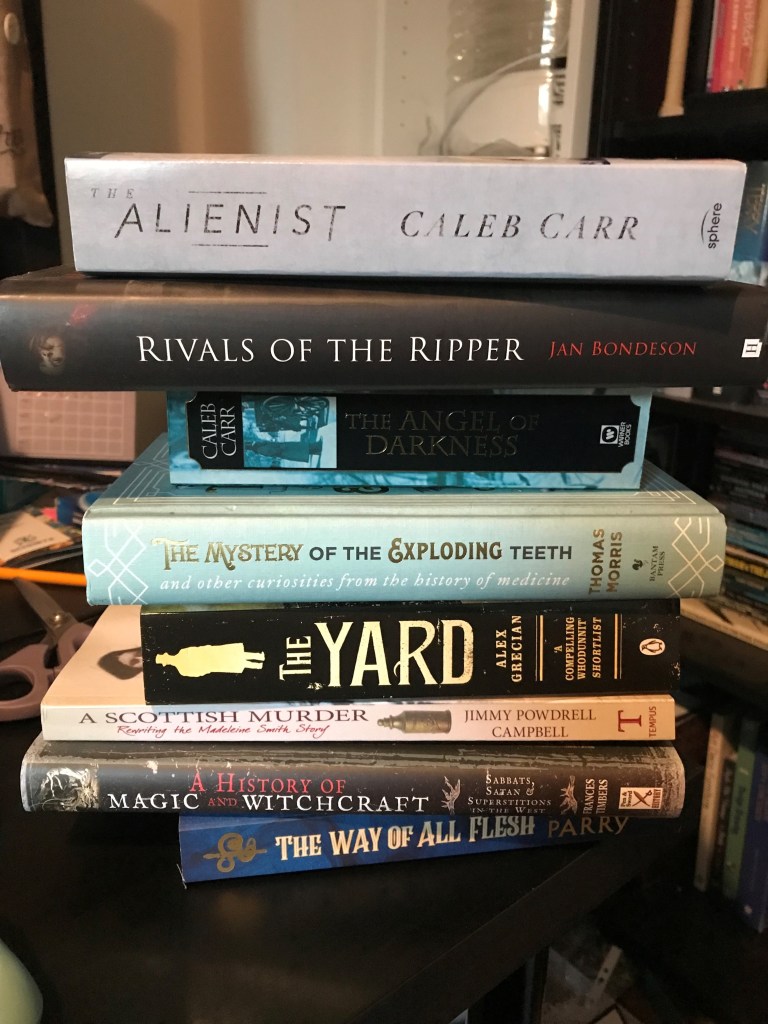
Yes it appears that I have a theme when it comes to my reading…Victorian crime anyone?
-
The case for Historical Research Pt.1
For myself, the inclusion of a historical perspective is an obvious choice when pursuing a research interest. From the age of 9, after being given the opportunity to mummify my cuddly rabbit as part of a school project on Ancient Egypt, I have fostered an ever-growing passion for history and its place and influence within our modern world.
Understandably however, PhD research requires a little more effort than the masterful crafting of the plasticine canopic jars that were to accompany my ‘Bunny Mummy’ to the afterlife (though such activity arguably required an equally high degree of skill and detail). One such expectation is to be able to provide justification for utilising an historical perspective. To explore history, one must show that there is a worthwhile reason to do so i.e., it must do more than evoke a romanticised vision of ‘days gone by’ or dreams of ‘simpler times’ (note: they were not ‘simpler’) in the reader.
While the goal to avoid what we shall term ‘nostalgia-bait’ is certainly desirable, the concept of having to justify history’s relevance feels most peculiar; history’s influence is everywhere and thus, its justification for inclusion feels obvious. Every thought, decision, interaction, encounter, event, and reflection has shaped who we are as individuals and further, who we are as societies and cultures. While no path is set in stone, to ignore the path already walked would render our lived experience somewhat incomplete, as knowing from where we have come can determine where we still must go; as George Santayana’s famous quote foretells:
“Those who cannot remember the past are condemned to repeat it.”
It could be countered that it is not the past, but the future that shaped our present, as our natural human ability to ‘think forward’ before acting can also influence our decisions (the perpetual “how will this affect A, B, and C?” dilemma). However, if we follow this viewpoint then, at the very least, it can then be argued that past and future bear equal relevance in the present as both have played an equal role in our development.
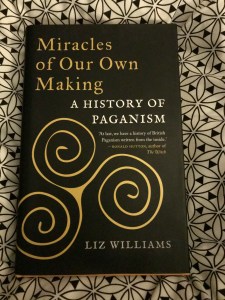
As mentioned, the influence of history is everywhere and as such, posts exploring the case for historical research will appear frequently here, or more accurately, as ‘evidence’ or ‘justification’ presents itself. The first such case stems from a recent reading: ‘The History of Paganism’ by Liz Williams. Before looking toward, the historical argument this book supports, there is a need to note that the influence of religion upon accounting and humanity is another strong interest, and undoubtably one for the list of ‘future research studies. Combining expertise from researchers such as Williams (2020) and renowned historian on Paganism, Ronald Hutton to explore the social connections between accounting and Britain’s ancient religions would be a fascinating realm of study (Hutton, 2014). Imagine the unique perspective and interest that such a connection could add to accounting and interdisciplinary research!
What makes Williams (2020) exploration of Britain’s ancient religions an excellent example of the relevance of historical research, is the journey taken to chart the growth of, not historical but modern paganism. Williams (2020) is not teaching us about ancient paganism, they are taking us through time to show us the ancestry of 21st century paganism. This approach places modernity in as the focus yet, we set that focus through walking backward through time. In utilising this historically based approach, Williams (2020) shows that although very little detail is known of ancient Britain, it can be seen that these lost religion’s ideals would come to influence and inspire future generations in developing their own modernised versions of paganism.
By mapping a timeline from 10,000+BCE to present day, there is a family tree laid out before us that traces the origin of 21st century paganism. The keynote here is that this a familial relationship thus, this suggests that we are not looking at the same entity but instead we are viewing generational entities that have ‘inherited’ the characteristics of their ancestors. This can be evidenced with Williams (2020) in recognising the familiar, but not historically confirmed, concepts embodied by ancient paganism’s modern ‘offspring’ such as Freemasonry, the Order of the Golden Dawn, Wicca, and modern Heathenry and Druidry.
Although as noted, the ancient and the modern iterations are not the same religion however, it can be argued that these modernised religions would not have been possible without their historical and ancient predecessors. Each generation embodied the perceived ideals of the previous iteration to build a religion that could attain a similar theosophical/religious objective within their own current societal contexts thus, creating these new alternate religions. It could also be countered that, in the absence of the previous versions of paganism, other influences could have led to the development of similar groups as Williams (2020) noted that some modern groups were politically motivated however, this would still support an implication that its development spawned from a form of historically-based social or human influence.
In terms of what this book can show us in relation to explaining why history is important in research. To invoke a metaphor, History is the foundation of society and humanity. It is true that a building does not stand through foundations alone, it needs structure; bones to make it strong, and skin to protect the precious content within. Thus, while there are many aspects needed to make solid research, without our historical foundations, our research may simply sink into the sands of time…
References:
Hutton, R. (2014) Pagan Britian London: Yale Univesity Press.
Williams, L. (2020) Miracles of Our Own Making: A History of Paganism in the British Isles. London: Reaktion Books.
Follow me on Bluesky
@lniezynski.bsky.social

