“The forces of evolution act upon a man’s tools as well as upon man himself “
A.C. Littleton (1926, P.12)
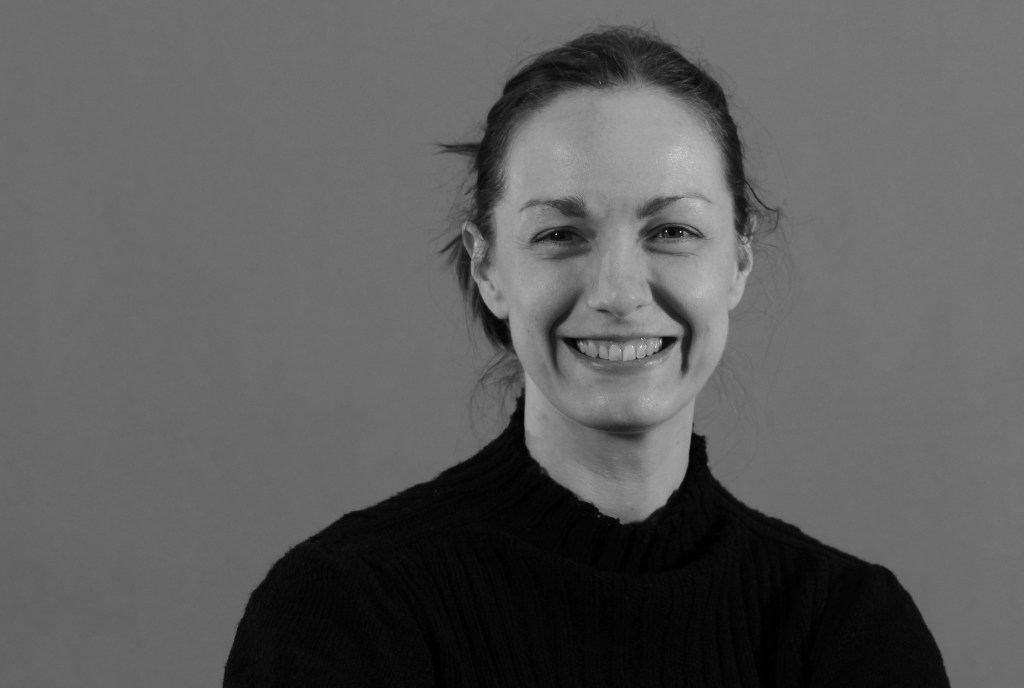
Welcome to the tale of an Accounting Academic who transformed into an Accounting Technologist, Accounting Historian, Accounting Anthropologist and a pretty decent knitter…
Dr. Lesley Niezynski is an early career interdisciplinary accounting researcher specialising in accounting technology, history and humanity. Lesley’s research centres on the interconnectivity between accounting, humanity, and technology.
Lesley has recently completed her PhD, a project centred upon the interconnectivity between humanity, accounting and technology through a study of Maritime Technology, Accounting and Merchants in Early Modern England.
Prior to accounting, Lesley’s interest in boundary blurring, human-centric research formed in her studies in Architecture, with studies in the interconnectivity of Architecture, Fashion, and Health.
What is she up to right at this very moment? Find out here.
I’m now on Substack! Find me at https://accountingforhumanity.substack.com/
-
Did digital technology make time worthless and invaluable at the same time?
Over the last few weeks, my thoughts have been turning toward the idea of “going analogue” and what digital, mobile, and smart technology has done to our concept, and value, of time.
Most recently, I found my frustration hit its peak when, on opening a journal paper, I was confronted with “this is a long document, save time and have AI write a summary”. This prompt, in my ‘grumpy lady’ view is everything that is wrong with this wave of Clippy*-esque AI.
Now, to clarify, I do not have an issue with the technology making things more effective, my problem is the encouragement of the idea that you are somehow incapable of doing these things just as well yourself, or worse, that you shouldn’t be trying, or learning to do these things yourself. Looking at the journal paper incident; I downloaded the paper to read it, regardless of how long it was. Even then, if I was short on time, I would read the intro/conclusion and then decide myself if it was worth reading any further. If someone went to the effort to write this paper (and I know them, so I know that they did), I am going to honour that effort by putting in the effort to actually read it ALL BY MYSELF.
The problem here was that the Adobe AI did not even give me the chance to make the decision about whether I would read it or not myself, it just confronted me with its decision; a “no you’re a lazy stupid human, let me help you and summarise it for you”. Worse still is the insidious nature, and the reasoning for this pondering, of the prompt: that whole let AI “save you time” approach. But if my time is for work, and this is work, what then am I saving time for?
*Clippy being that infuriating little Microsoft paperclip who insisted on annoying you at every possible juncture in the spirit of “helping”.

https://clipart-library.com/clip-it-microsoft-word.html I’ll sleep when I’m dead: The Trouble with “hustle” culture
For most of us, the beauty of technology is this idea that it makes a lot of things faster and easier. What can be better than getting those pesky tasks out of the way in record time, and without compromising the quality of the output right? It’s not just even about AI either, excel can do the math, word can do the spell check etc., etc. Imagine the days when you wanted to reach someone a quick question, you have to traverse the office to actually find them?
The argument for such innovation is arguably that by removing/hastening the time consuming yet non-critical work, time can focus on the the important stuff and thus, more is achieve during working hours. There was a time when the idea behind this was you then get more “quality” time outside work, i.e., more time spent with loved ones and/or doing something you enjoy. However, at some point this idea corrupted and split into two rather depressing ideas; first is that with technology you can do more work AND you can do it all the time, no matter where you are; and second, even if you get that “free” time, you spend it doom scrolling on social media!
I have worked in places where this concept of being “available” 24/7 was expected. Feeling the need to justify not seeing an email because I was asleep at 5am when it came through (the audacity of me). Worse still, I bought a “work only” phone that I would switch off when I left the office (the double audacity!!). With mobile technology and the internet, we are more connected than ever, we are forever visible, and part of me is beginning to think (in some ways) that this is an awful thing. There was a time when the idea of going into the (home or actual) office, booting up the computer and logging on to the internet to do work in the evenings or on a Saturday was inconceivable. Yet, as it becomes easier to “send a quick email”, “just jump on a quick call”, or “just give this report a quick read” on your phone, there is a growing idea that you should be simultaneously switching in and out of “work” mode.
As a counterpoint, yes this does introduce a much needed flexibility into the working day (not everyone was designed for a smooth running 9am-5pm). However, the problem becomes that we lose sight of just how many hours we are giving to work. The system moves from a rugby method (stop/start until you hit the total time) to an on call approach where you have no idea if you have worked 35 hours or 80. Our 7.5-8 hour working day has evolved into a ‘Co-pilot’ shadow forever lurking behind us.

Behold my beautiful, crafted on PowerPoint, representation of Hustle Culture! What also becomes an issue is that your phone/social media is also exposing you to the idea that rest is for the weak. Let us say that you ignored the temptation to send that work email, opting instead to have a quick look on social media. Here you are introduced to an onslaught of content promoting the “hustle” culture i.e., if you’re not working, you’re losing. Social media is abundant with content guised as “motivation”, to get you working out more, putting the hours in and never stopping. You skipped the gym? You’re an awful human being. You wanted to spend the weekend with the kids? You don’t deserve that promotion. There is no time or patience for slowing down, rest is for the lazy and sleep for the dead. In this world you’ve got to keep on moving and “monetise, monetise, monetise”. Yet here is Adobe AI, actively trying to make me lazy by not allowing me to read a paper for myself because it’s “quite long”…
As the prominence of this concept of 24/7 hustle/grind grows, our main question forms: why?
Looking at influencer culture, the obvious idea would be to achieve (financial) success, to be like them, visions of the “ideal”. There is also the merging of the old and new ideas, you can have success/money in a way that gives you more time to enjoy life and be #blessed (I know we’re long passed that era but I am woefully behind on popular language). However, most of us by now know that what we are seeing is a smokescreen, snapshots of a manufactured image so, is it still about adopting technology to have more time to enjoy life?
But if life is all about the hustle, then what is this pursuit of extra time for? Are we saving time to work more, or to die having never enjoyed the apparent spoils this eternal toil brings? As a society we have found ourselves at a juncture that fails to make sense, our concept of work has morphed into a lifestyle and identity, it’s not longer part of life, it is our life. Time is money and money is what we should all want so time inherently becomes financially valuable. Time wasted is money lost…
Yet riding high on the AI wave is the concept of having AI do everything for you. How does one hustle if AI is doing everything for me? If I contribute nothing, how can I expect to earn anything in return?
“Free” time?
For most of us, particularly in what feels like a continually worsening environment and (let’s be honest) disgustingly growing wealth gap , the all consuming work mode is about survival (my argument is not about this, that is a whole other significant issue/injustice). For a lot of us it’s not “hustle culture”, it’s working extreme hours/multiple jobs just to make ends meet, not to post “content” online for the “likes”.
However, let us look at this “hustle culture” concept again. As noted, the idea is to get rich/famous. We should be aspiring to be like the super rich and to do that we need to be “on it” 24/7, no breaks.
The hope of course is that there will come a point where you can stop and enjoy all that “free time”, but once in you’re in this race, time is money, there is no “free” time. Time is monetisable, if you aren’t monetising you’re losing. “Wasting” time then is truly a luxury (and actually yes, those times when you actually get to enjoy life are priceless), so why then, when we’re done “hustling” for the day, or if we take option B and have AI do all our work to “save time”, do we sit down and spend all that hard earned time endlessly scrolling on social media?
Welcoming the Conundrum: Time is worthless and priceless
Here in we find the problem, we are being taught that time is so valuable that we should be using every fraction of it for monetisation but, at the same time, we spend hours needlessly scrolling through social media, the so-called “doom scrolling” and “brain rot”. If productivity is key, surely this is the worst use of our time?
The truly more bizarre part of it all is this. We work ourselves to the bone, sacrificing almost everything to sit and watch other people doing the things that we used to enjoy online (or arguably pretended to do those things “for the likes”). The time we worked so hard to earn is given over to nothing, or worse, it becomes guilt as we convince ourselves that we are either not working hard enough or that we do not deserve to spend time on enjoyment.
Even for those who try to reclaim their time we find another issue, the monetisation of hobbies. Hobbies are vital for mental health, they are that chance to escape from all the stresses of life, reading a book, painting, going for a run, etc. They are supposed to be things just for you, you should not be made to feel guilty for not either monetising them or sharing them with the world for “content”.
So here we are in this strange technology-induced predicament. Social media tells us we should be hustling, inspiring, rising and grinding, insert random “motivational” (note: often not actually that motivational) quote to seize the day. Furthermore, you’re not really seizing the day unless everyone knows about it, I don’t want to go for a run in the park, I want to watch you on TikTok going for a run in the park (though I lie, I don’t like running and I don’t use TikTok, but you get the idea). So once we’re getting our minds around this, suddenly in walks AI offering to do all of this for us to save time. We don’t have to go a run, AI can make a video of you going for a run, AI can write that report, AI can read that other report, AI can schedule those meetings for you. Great! Now we have adequately shown that we are not required for our job as AI can do a mediocre/acceptable enough effort we can enjoy those 12 hours of “free” time, so what better way to celebrate that catching up on all those “for you” reels/TikToks and imagine what it must be like to do all those fun things we could be doing instead of watching them through a screen…Thanks AI!

If you give yourself time to try things, you might just find crocheting a faceless bear and making them a Tudor Ruff is actually kind of fun -Disclaimer-
I say this often but, I am very aware and supportive of AI, my rejection is of the abuse/misuse of AI. I know that GenAI can be great to enhance accessibility but I do not agree with it being used to steal/replace creatives. AI can also be exceptionally useful in the workplace, I am aware of some great developments in archival transcription AIs (I’m trying one out at the moment, it’s not perfect but it does provide a good baseline for me to then properly transcribe afterwards). Also yes, there are amazing examples of AI saving lives through detecting cancers well before any human could. I am not anti-AI, I am anti-anyone claiming humans can’t/shouldn’t do things ourselves when possible.
-
Goldilocks and the three research conundrums
As I find myself now nearly 8 months out from my PhD (or the viva anyway), I am becoming ever more aware of the difficulty in choosing direction.
For me it feels like there is a mysterious dilemma in research, there is this line somewhere that, one one side, you stay centred and become an “expert”, but on the other side, you go “rogue” and become the dreaded “Jack of all trades, master of none”. I know this is an early career interpretation, maybe in time I will indeed learn to take ownership of said line. However, for now, it very much feels like my path has suddenly splits into 3; the “too much of the same/boring”, the “all over the place no focus/expertise”, and then there is this one in the middle that’s “just right”. The choice seems obvious right? There is a problem though; this 3rd path is incredibly difficult to traverse.
Post PhD – Imposter Syndrome
I admit I was very lucky to not have experienced imposter syndrome during my PhD but, once the clarity of the PhD fell away leaving me free to run off into the world, I learned that this freedom comes with a price.
I can research whatever I wish now, every whim can become a project, a paper, a thought piece. But, if I seamlessly flit from one place to another, will I be taken seriously as a researcher? Should I “pick a lane” and stay in it, does that help gain me entry into research circles? How do I know what exactly my “lane” is?
The idea for my thesis was never for it to be a “one and done”, I very much view it as the beginning of a collective body of research however again I face another dilemma, what stops a collective/expertise from becoming a “one trick pony”?
On top of all of this is my interdisciplinary background. I carry art/architecture and accounting thinking in my blood; they are inseparable, I cannot remove design thinking from social sciences critical thing. Now I fully view this as strength, my mind exists in two powerfully critical and interpretive worlds but, this can mean that I forever live with the question; is this “accounting” enough to be accepted?
The Silver-ish Lin(e)ing?
Part of me very much wants to embrace the Edward Gorey approach and proclaim “GUFFAW!” to the norm, but I also know that Gorey had to create his own publishing house to give many of his works a home, and even with this, it is mostly is externally published works that he best remembered for.
So as I fine myself battling with this line or 3-part path (side thought: maybe the line is the 3rd “just right” path?) there is one helping hand; history.
My PhD was a work of accounting history, and history is a vast field. Therefore, if select my “central field” wisely, I can give myself the needed tools to traverse that 3rd path. The key however, will be making sure that foundation block is solid.
Accounting for Humanity after all?
As my thesis and I move into this next phase of life, we have collected a crew of outcasts to join us. My interests have delved into death and funerary research, Scottish business and banking history, social and state power, the Scottish Witch Hunts, and of course, the impact of technology remains central.
Looking at this though, something does stand out. There is a thread running through all of this: Humans. In the early days of my thesis, and of this blog, I often spoke of the desire to be an “accounting anthropologist”, and I think that is coming to the fore as I embark on new projects and papers.
I cannot say if this “is it accounting enough” issue will ever subside, I may forever be struggling against this phantom research line, but I cannot ignore that accounting exists because humans made it so. Accounting is so deeply engrained in our societies that, once you find a connection, you see it everywhere; and I think that is something worth a second look.
Where is this going?
If/when I read this post back, I will undoubtedly see a plethora of non-sensical, contradictory thoughts and ideas. However, the act of committing these confused thoughts to “paper” does make them seem less confusing.
I’m still standing before this 3-pronged fork in the road, but I am slowly figuring out the tools I need to tackle the path I want to take. The thing is, none of these paths are wrong, but I do need to make sure I am well equipped to handle the one I choose.
So for now, I am not going anywhere it seems (anti-climatic I know), but I am building up to it. At some point I will have every thing I need and I will take off running into the future. But for now I will, as the old song goes, “pack up my troubles in an old kit bag and smile” as who knows what tomorrow may bring…
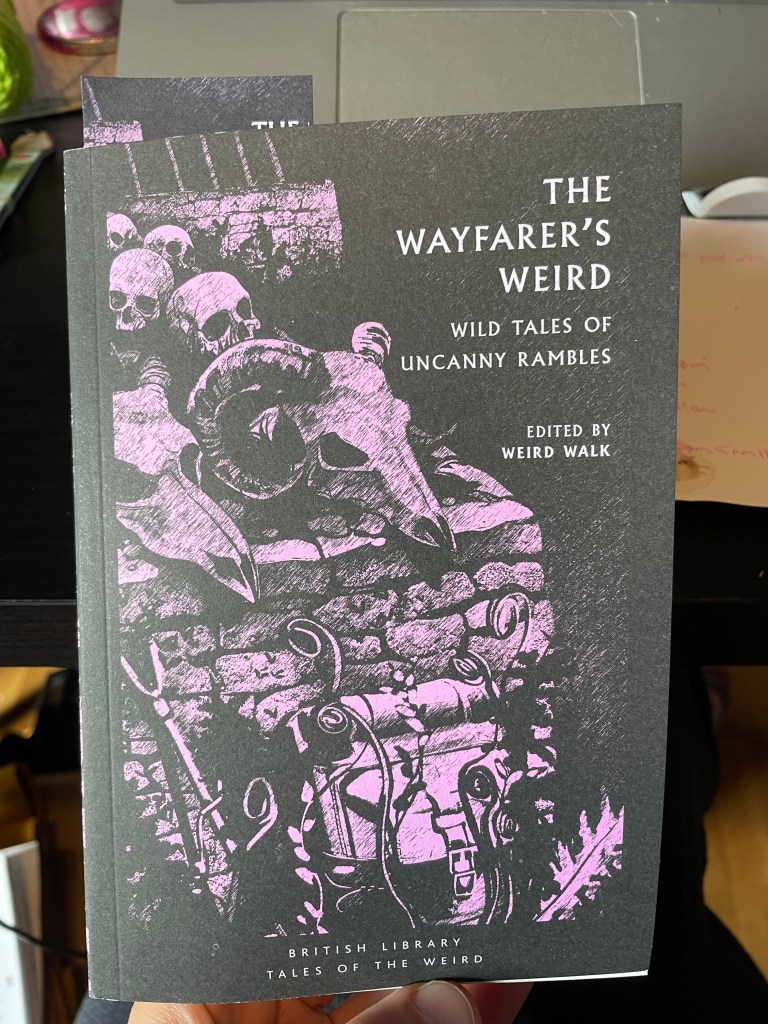
(A vastly appropriate book to represent this post I think…)
-
Getting to Grips with Engagement
From the beginning of my PhD, I noticed the word “engagement” getting thrown around a lot in the university (and in a number of other academic events I would attend). My initial reaction to this was abject fear as I pictured me trying to do research with children (while I have learned that I do actually really enjoy teaching in Higher Education, children still frighten me), in short all I could see was chaos and terror.
As I have now gone through and emerged from the other side of the PhD, I see now that engagement is far more than reading to children (I really have no idea where I got this idea from but it cemented itself in there at some point). Over the last two months in particular, I have even gotten to try out “engagement” and I have to say, I really rather enjoy it too.
Making a real difference: cliché? I think not
My first foray into “engagement” fell on Halloween of all days, arguable on theme with the terror idea but then, I rather like Halloween. I took part in my first public talk with Remembering the Accused Witches of Scotland (RAWS), forming part of trio discussing the history of the Scottish Witch Hunts. This was the first time I had actually spoken to an audience who were neither of the academic conference nor lecture students association. I wasn’t nervous, quite excited in fact to be speaking without the burden of critical appraisal. As hoped, the talk went well and I was met with enthusiasm and questions. Reflecting on the event afterward, I noticed my primary impression was a huge feeling of reward. Firstly, it was hugely gratifying to be speaking to people who (voluntarily) signed up to listen to you. Second, there was a great sense of joy in knowing you had made people happy and/or enthused about a subject. It was this sense of enthusiasm and interest that struck me, as it was something that I just haven’t felt so strongly in an academic setting.
That is not to say that academic audiences aren’t engaged/interested (quite the contrary), but it is a more “clinical” setting if you will. Usually the audience is there for reasons in addition to pure enjoyment and interest, usually learning course material/providing peer assessment/feedback of research. A public audience in contrast is there purely out of the enjoyment of learning, a “non-captive” captive audience in a way.
I followed this event up 8 days later with RAWS first in-person conference, “Remembering the Forgotten Voices of the Accused” in Glasgow. Again, I presented here with my fellow RAWS trustee, sharing our recent exploratory research of witch trial memorials. This too provided the same rush of enthusiasm, reward, and joy from the audience. This too stemmed from this lightened sense that you’ve been able to give knowledge to people without expectation; you aren’t there to get publication tips from them, they aren’t there to meet a regulated learning criteria.
I should highlight that the key observation here is that this conference was a “public” conference, not an academic one. Returning to the idea of the academic conference and why it feels different; for academia there is perhaps more of a transactional sense to a conference; I very much enjoy them yes but, I am sharing my work with you from a perspective of very much expecting some sort of review in return. This transaction can still be positive yes, but primarily it is to be useful rather that emotionally uplifting, it’s intent is fulfilling a career development goal. Therefore, in a way, the academic conference is almost selfish (not in a bad way, but in the sense that you are there to help yourself) whereas public engagement is about being their for someone else.
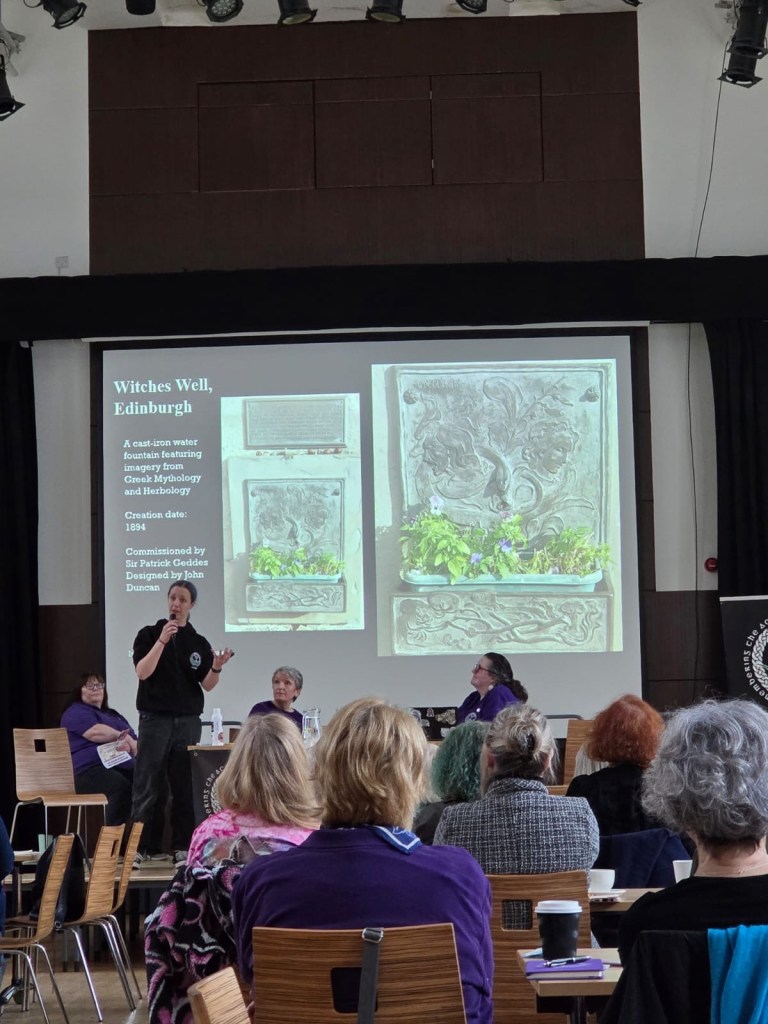
Image courtesy of RAWS Another foray into the land of engagement has been joining the Friends of Greyfriars Kirkyard (FOGK) committee. This spawned from volunteering at their “Doors Open Day” in September and again finding the opportunity to share history with the public to be a thoroughly enjoyable experience. While I admit there is a degree of selfish/self-indulgence here (any chance to talk about history for me is worthwhile), there was still something utterly wonderful in giving people an insight into the past. Not only was this (as noted) a chance to talk about history to people wanting to listen, this was advocating for the preservation of a significant site in Edinburgh while simultaneously introducing people to the rich history of Edinburgh itself.
Ok so let’s do both then
Now fully aware of the reward you can gain from engagement (and very importantly for my strange delusions, does not have to involve reading to children), there is the question of how then do I do research that can encapsulate all of the above? How do I do the career developing stuff in conjunction with the reciprocal pursuit of “giving back through knowledge”?
Post PhD can often feel a little like being adrift at sea. Where once there were set goals/objectives/purposes, now your somewhat left entirely to your own devices. You’ve set sail, but where are you actually going?
Yet, through this engagement work I have found direction. For me this has indeed formed quite naturally through these ventures with RAWS and FOGK. I see now that I can pursue projects that can actually deliver insight and meaning to these groups that I have joined. I can shift from “where are the gaps in the research” to “what can I do to help these endeavours succeed”? Further still, I find myself directing attention and other research ideas toward “what can I do engage the wider world with this” in addition to “can I get a publication out of this”.
Sadly I know that vicious publication cycle will never go away, everyday it feels more like the “get a job for experience, but you need experience to get a job” loop. However, now I feel like I can look a little wider, I can see that there is impact and reward to be had beyond publication metrics. It is incredibly cheesy but, growing up (and even now) I always wanted to make some kind of difference and impact in the world, and now I feel that, through engagement, I might just be able to do that.
-
Seeing your life flash before your eyes…in an Edward Gorey story
On my quest to make an acceptable dent in my “TBR” (“to be read” for those peculiar creatures that have read all that they own) list, I finally made my way to Amphigorey: Fifteen books by Edward Gorey. All fifteen tales were magnificent however, it was the first, The Unstrung Harp, where I found myself reading a frighteningly familiar tale.
The story follows Mr Earbrass and the journey that is writing his next novel. As we move through we find Mr Earbrass sailing through and excitedly thinking up characters and plot lines to suddenly being hit with the notion that his work is terrible. In addition, we are presented with the woes of publisher edits, cover designs we hate but feel compelled to accept and the inevitable “numbing” acceptance of the fate poor Mr Earbrass finds himself in.
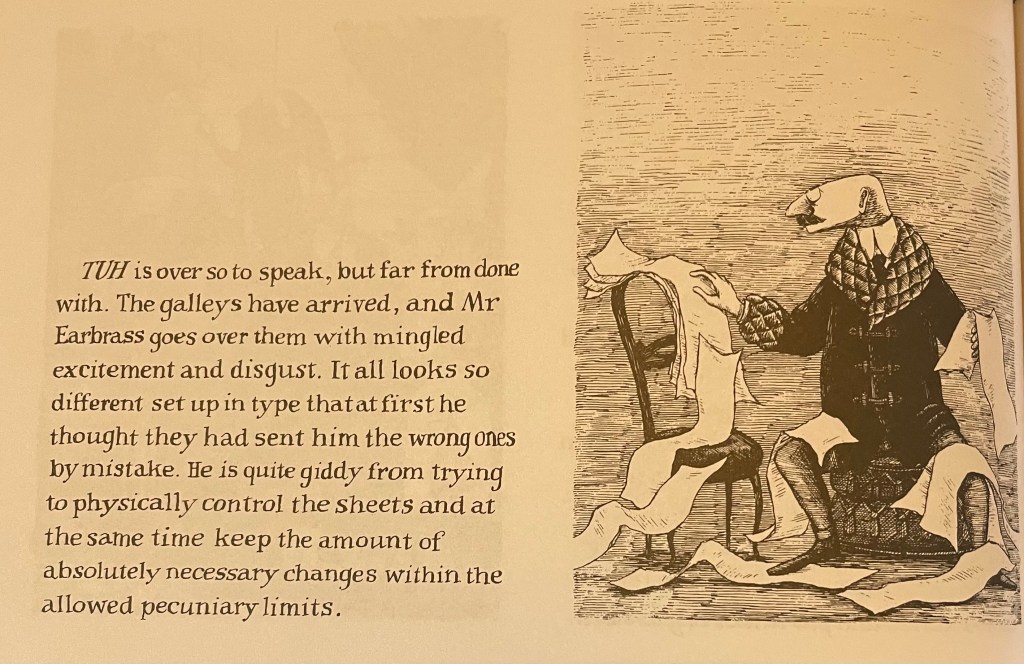
Taken from Amphigorey: Fifteen Books by Edward Gorey I accept there is an obvious overlap in the world of book (fiction and non-fiction) and academic publication writing however, the plight of Mr Earbrass felt horribly profound to me. This is process is exactly what writing papers feels like.
Recently I worked my way through my first paper. I felt I was onto to something great’ novel, unique, quirky yet “translatable” to academia. I enjoyed writing it and really got into it but there came a point where I started to fail to see or understand what I was doing. The paper had become a conflation of my idea with some contortion of an idea that I thought would be more palatable. Like Mr Earbrass, I thought some clever moving around and minor tweaks would be the solution but I swiftly learned this effort was in vain.
The paper was rejected (first rejection of my career, so now I am bona fide academic) and, like Mr Earbrass, went over the suggestions with excitement and disgust only to realise that I would never be able to keep the necessary changes to within the said pecuniary limits. And so, unlike Mr Earbrass, I cast it into the pile/chasm of “the forgotten works in progress”. While this sounds defeatist, part of me stands by the decision to part with the paper before reaching that level of numbness reflected by the dejected Mr Earbrass. If the feeling isn’t right, sometimes you just have to let it go.
Now my rejection was a few months ago but I am again in the process of developing papers. I am trying to find my feet as a writer and there is something wholly comforting about learning that these odd conflicting emotions are normal. At times there is a sense of writing being a love/hate relationship. I go from feeling strongly in my “forging my own path”/”this is going great” to “oh my God what am I even doing”/”this is awful no one will publish this” multiple times a week. There is a view that I need to find some peculiar balance between what I am as a writer/researcher and what is expected of me as a writer/researcher. However, I wonder if in fact this belief is what holds me back…
I have noted before that I am a huge admirer of Gorey. He developed his aesthetic/style (sinister cozy in case you are wondering) and he stuck by it. When his work was rejected, he saw this as an indicator that he had not yet found the right home for his creations and, if he could not find a home, he made his own; creating a publishing company to house it himself. On the other hand, when Gorey’s work was accepted, he embraced the opportunity it brought and flourished under the eyes of his fellow minds/weirdos (I mean “weirdos” as the highest possible compliment).
The Unstrung Harp and Mr Earbrass’s painful endeavour is thus perhaps a reminder of many important lessons. Here are a few I picked up, I expect there are many more and that they will come to me in time.
- Writing is not easy. Ever.
- There is a choice to follow your path to the end or to step off onto someone else’s path, it is your choice
- If you truly believe in something, stick with it, sometimes you just haven’t found the right home for your ideas yet
- Maybe controversial but: Sometimes the end goal is more important than the vision (i.e., do you need money/publications more than vision), and if it is then it might be best to “numb” yourself to avoid becoming too precious over your work
-
Recent (self) publications
I always struggled with my plans for this part of the website. It feels important to have the blog but, as a self publishing platform it felt “messy”. I have always wanted a place designed for reading articles of literary pursuits whilst having a less formal area for all of the other adventures that occupy my life.
In the beginning, I certainly tried to have them coexist here in the blog but I never liked the result, I wanted my more formal writing together and separate from these more em… “unhinged” thoughts.
So when I discovered Substack my writing dreams were met. It is a platform designed to create short to long-form written content and it offered a neatly “all in one place” location for my publishing.
So, while I will occasionally post publishing updates here (as I am doing now), I can now centre the blog on less formal writing (reflections of events/experiences etc) and Substack will be my self-publishing repository.
So with that in mind, here’s a breakdown of my recent Substacking.
My thoughts on why AI will not end accounting
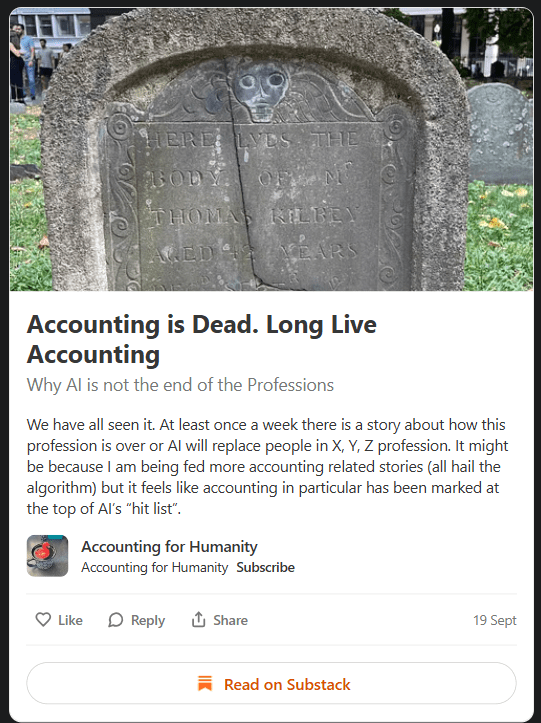
My first foray into Substack is an opinion piece on why accounting will survive AI. While discussing the future of accounting as a human profession, it is interesting to also consider that the research that prompted this opinion would not have been possible without historical information. Keep that in mind the next time someone tries to claim that history is not valuable…
An (over)thought Piece on Star Trek and Society
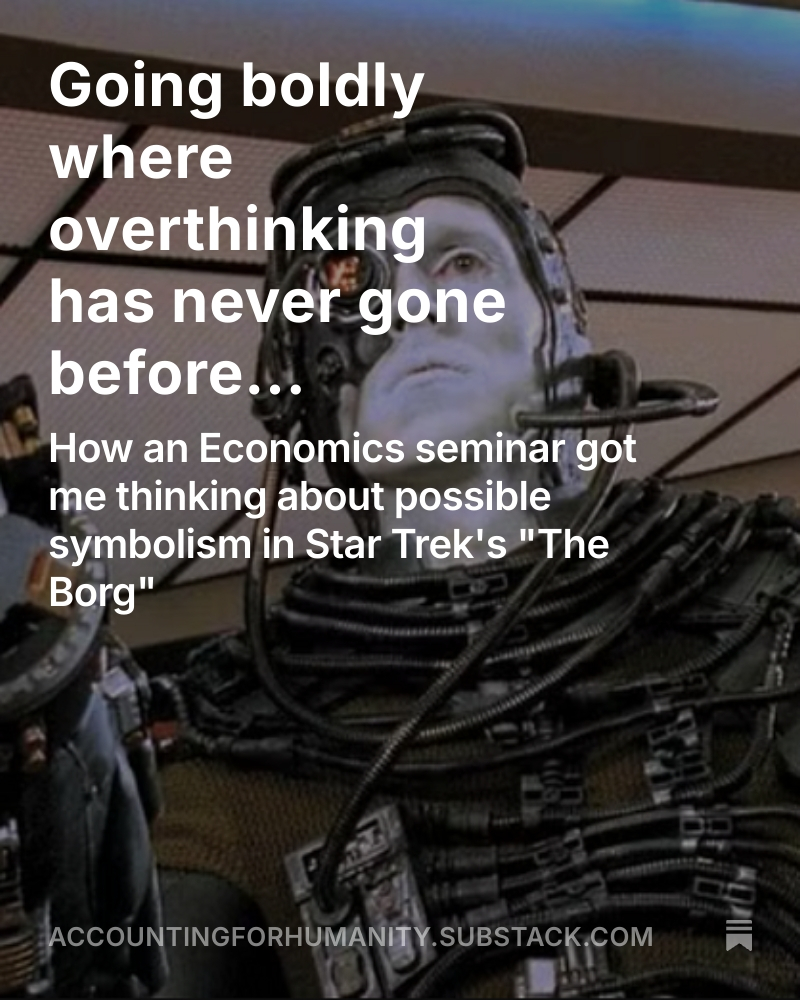
I shall be honest, it is probably better to read this one than ask me to recount it!
Finding Accountants in the land of the dead
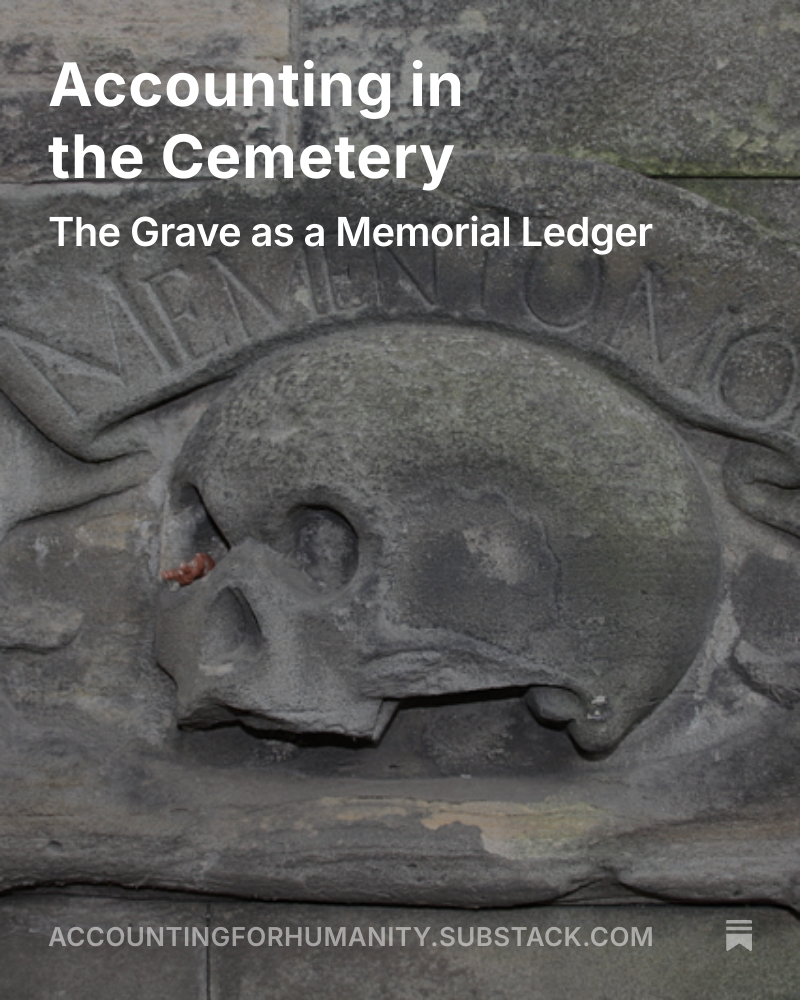
This is one of what will be many pieces expanding into my Taphophile project. I do hope/aim to generate some “peer-reviewed” publications in this project but, at this stage I am focusing on self-publishing to allow me (and my readers) to fully explore those very intangible ideas without being confined by the boundaries and structure of peer-reviewed works. These “bite-sized” articles will introduce some of my thoughts, reflections and discoveries as I peek beyond the veil of the living and the dead.
The Dream project: Taphophile’s work of Academic Fiction
This is something very special to me. This I admit grew from my first academic paper rejection. My feedback told me that 1. I did not make my “vision” clear enough and 2. the reviewers pretty much HATED my work. This made me realise that if I really wanted to freely create something that embodied the manner in which my mind combines art and academia, I needed to do it myself (i.e., self publish). It is not intended as a self indulgent or embittered “no one gets me or is good enough to see my vision”, honestly I felt the feedback for my rejected paper was fair. What this is though is a recognition that, if I take such a passion project through a peer-review process, I will emerge deeply hurt and lose the passion that drives this idea. I am too early in the academic career process to do something like this formally.
Therefore, “The Ledger of Death” combines my undying want to write a story and share my research into accounting’s influence on life, death, and death’s architecture. The tale follow’s the journey of a newly minted soul, looking to understand what on earth accounting has to do with getting to afterlife. Guided by Charon the ferryman, we will answer the question of how does accounting connect life and death?
The Weird idea of Gender Identity: Book Review
After a particularly interesting/though provoking issue of the British Library’s “Tales of the Weird” I got to pondering how society perceives what it is to be a woman in the Victorian Era (and how that links to a recent paper I read on women in accounting)
Last, but not least, a quick ponder on an unexpected discovery in the Archives
If you are short on time, then this quick little entry makes yet another connection between accounting and death.
-
New (first) Article on my new Substack
-
Your (artificial) mind or mine? Is AI making us stupid, or are we making AI stupid?
This is a brief thought (maybe, I say that a lot an then write an essay) that quite regularly passes in and out of my mind. When we talk about Artificial Intelligence, how intelligent are we actually talking?
Now, as a disclaimer, I am not referring to the highly advanced, technical wizardry type AI’s that do in-depth data/statistical analysis. I am looking at this more “public” AI that is seeping into our everyday lives (I swear EVERY software I use now has an AI assistant that has somehow managed to make itself more annoying than Clippy). I am also not suggesting that I am an expert on the inner workings of AI (I am undoubtedly, and ironically, misinformed to some degree about how it works), but my basic understanding of how we as as society are using or interpreting it is a valid opinion.
Stupid is as Stupid does
My (currently) passive concern is the reliance and belief society is building that AI is infallible, perfect, superior. We seem to overlook that GenAI or these public open access variants do most of their learning by trawling the internet. The same internet laden with misinformation, conspiracy theories and harmful discourses/narratives.
Thus, two issues arise here. First, if we blindly believe what AI tells us, there is a good chance we will be living our lives hugely misinformed. Second, if we are thus living with half truths and fabrications, it is likely that any content we “create” (i.e., if we even create it at all or use another AI to do it for us), we further dilute the quality of information available to the AI to learn. So begins a downward cycle of Artificial Intelligence becoming Artificial Ignorance.
So…Are we the problem?
Before going any further here, lets recall Tay, the AI-powered Chatbot that went from a novel idea to a racist, antisemitic nightmare (https://www.bbc.co.uk/news/technology-35902104). This highlights the problem that (attempting to give benefit of the doubt) there is a lacking awareness that plying AI’s with harmful or frivolous (deliberately false or comic information to confuse it) can lead to valuable and beneficial information being degraded if the volume of negative information is greater.
Think for example how children learn. At the moment AI is learning from us thus, we need to consider that we hold a degree of responsibility and accountability toward what we choose to teach it. Furthermore, there is also perhaps a need to reconsider how we view AI. It is the 21st century rendition of the printing press i.e., this a technology/tool to give us access to new sources of information to enhance our learning and knowledge NOT to supersede or replace it.
It’s a marriage not a war
So what is my point here? For lack of a better analogy, AI is not something we should fight against or seek to destroy but it also is not our knight in shining armour. We both need each other to do our best if we are going to succeed. As a human you possess the gift of critical thought, hold on to that, you are going to need it. Stop thinking that AI knows everything and (more importantly) that it is right about everything.
We are at a critical stage in our (and AI’s) life, we can work to make both of us reach the next level of knowledge or, our lack of self-worth can lead us done a dangerous path where we think all though extra limbs in the photo’s are real…
-
The Semester is Nigh
As a sign to my growing older, I can affirm that time is certainly moving too quickly. Out of nowhere another academic year has catapulted onto the shores of Lesley time (if my thesis taught me anything, it is clearly travelling via race-built galleon).
As a side note: This idea of time accelerating is something I personally (and coincidently) noticed when I started life as a university student. Time is split into these concentrated 12 week bursts, and before you know what’s going on, the degree was over. Annoyingly though, when I left university, time refused to return to its normal pace, and here we are 16 years later still trying to figure out what’s going on.
Returning to the main thought, another academic year swiftly approaches but, this one will not be like the others. This will be my first academic year without my thesis, which feel exceptionally odd. I doubt my schedule will change all that much, after all now I am feverishly working to make my name and place in this academic world, but technically when I am not teaching, I could be doing virtually anything. For someone like myself i.e., someone who absolutely expresses interest in too many things (see my Happening Now page), this is going to be difficult.
Thankfully, I believe my challenge is a good one to have. I am fortunate that although my thesis is done, my interest in it is not. I know for many the all-consuming nature of the PhD means that, once submitted, you never want to see it again. This can leave you a bit lost on where to go next, so I am thankful that I have managed to maintain a want to keep expanding my work. My hope is some thesis publications and a new “thesis-expansion pack” i.e., research project building on my PhD findings that I can get some funded support for.
Before, or alongside, all of that though is teaching. I’ve had one semester as a lecturer already thus, I am already actively building and developing my “lecturer persona” (or style, I am entirely unsure what to call it) to be someone students want to, and enjoy, learning from. On this note, for the first time in my 39 years of life I have an office (as in a proper room, not a desk on an open plan floor)!
As this is peak “fancy” for me, decorating the space has been a source of much amusement, so we shall end this very quick and random post with some of the additions to my office…
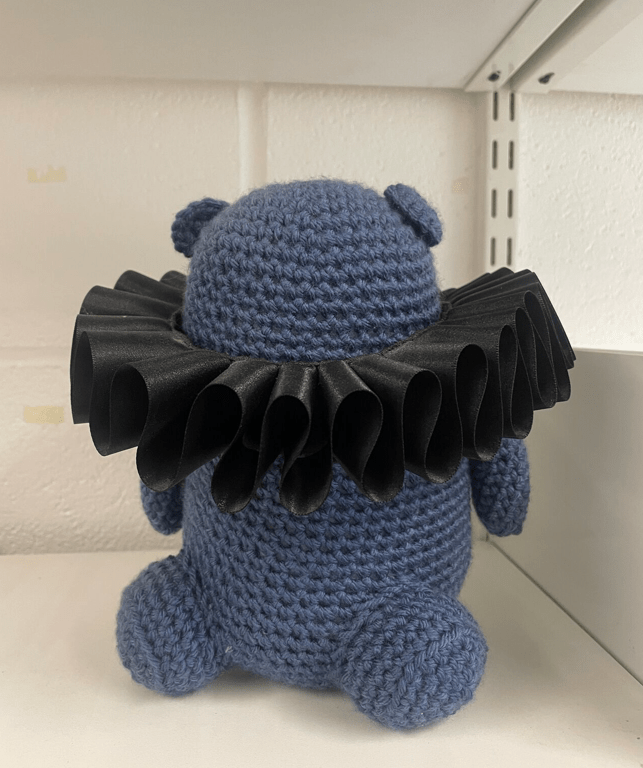
‘Tudor Ted’ – I crocheted Ted and made his delightful Tudor neck ruff 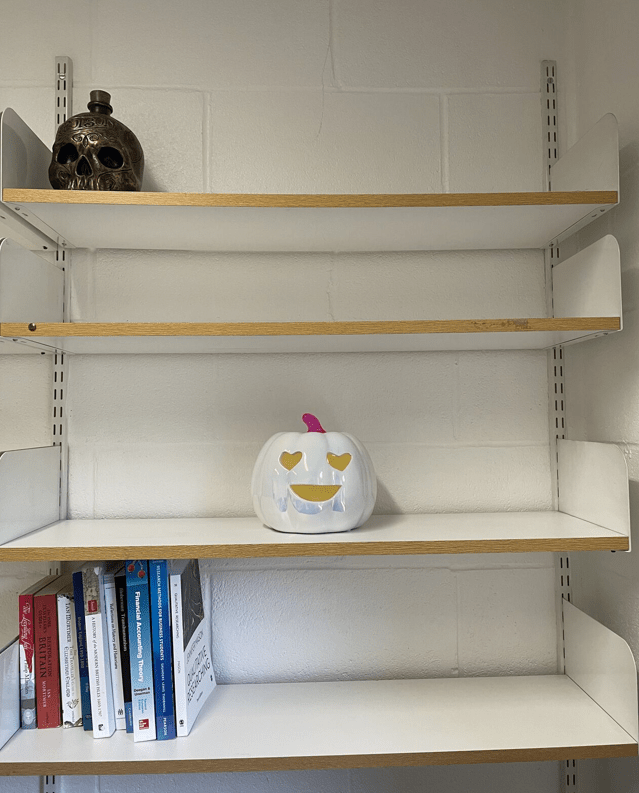
Some of my “Halloween haul” finds at TK Maxx (since taking this I’ve also filled two shelves with books) -
What happened next…
It is just over one month since I passed my viva (1 month, 2 days but no one is counting obviously…) and it felt like a good time for a quick bit of pondering.
It is possible that it was just me, but a large part of the PhD was wondering what it would be like once it is over. I will admit, my thoughts involved a far healthier and prosperous job market (as someone who finished their undergrad as the 2008 credit crunch hit, I should have known better) but putting that aside, it is this immediate aftermath period that I never really considered.
While PhD’s are “self taught” pursuits, there is still some structure around them, that being you are pretty much always working on your thesis thus, you know what you are planning for/working on. Post viva and corrections though, this “freedom” feels suspicious, like being left alone with a box of chocolates, you can technically take whatever you want but, you are waiting for someone to appear and tell you off for doing it (weird analogy yes, but I am currently sitting – unsupervised – with a box of chocolates).
I have a great and growing ideas and to-do list but, at the moment, the discipline to focus on building a plan for them is lacking. I suppose the natural thing in the immediate post-PhD stage should be to stop, relax, take a breath and get ready for the next stage but there is definitely a battle between this sensibility and being a “kid in a candy store” mentality here. I want to rest but I also want “to do all the things”.
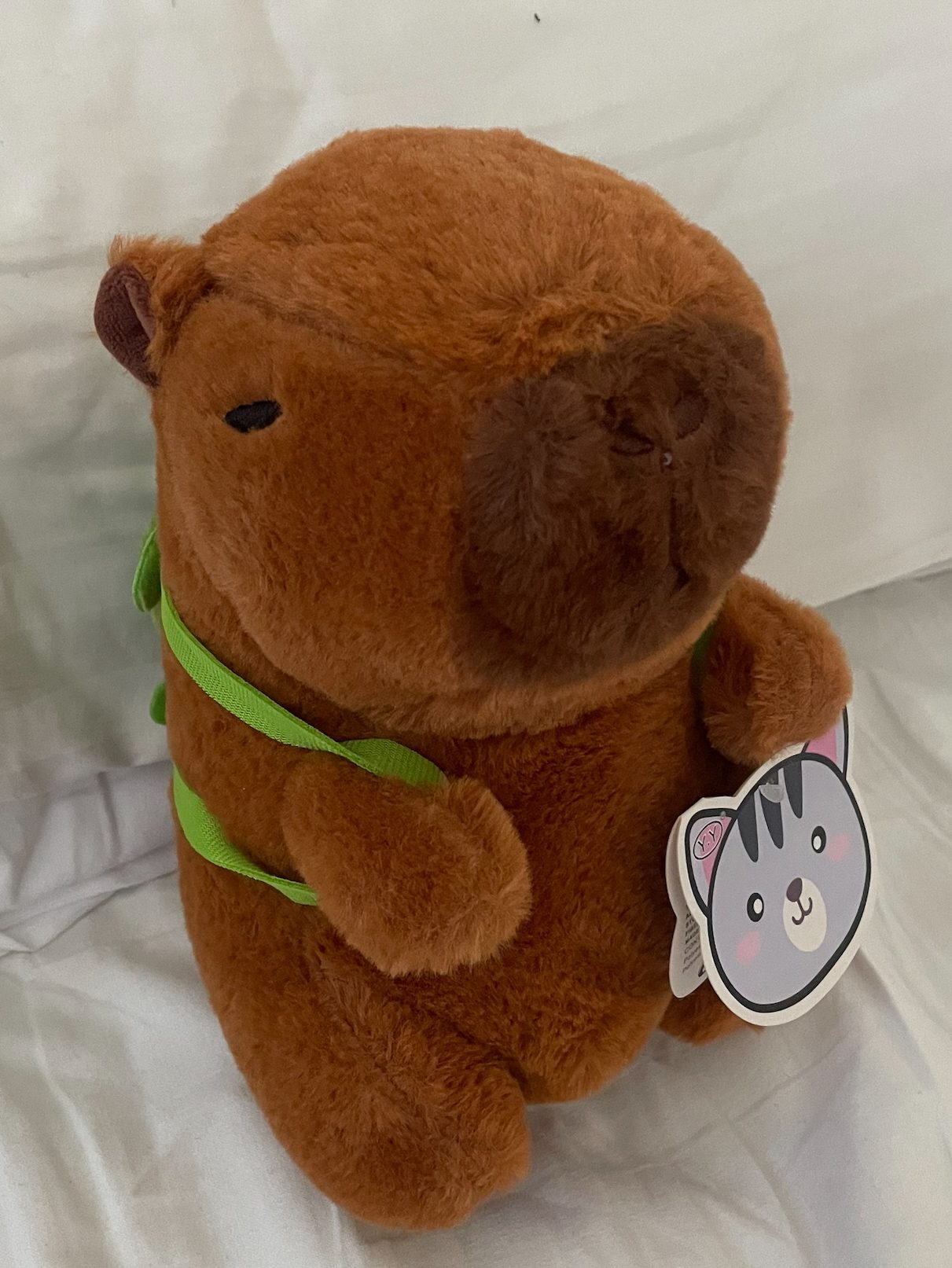
So for now I am alternating between relaxing and planning/working on my ideas for publications and projects. But, to prove that I did take some time off, I include exhibit A: Steve the Capybara, who I purchased on holiday. Because, as you know, I am now a very mature post-PhD academic…
-
Which road will you choose Dr?
I am very pleased to report that 2 weeks ago today I emerged successful from my PhD viva (pause for celebration). But now, as you might expect from me (or if, not then I will tell you now that I cannot resist the opportunity to reflect), this is a milestone that induces much reflection.
“Discussion” or “Defence”?
The first thing that struck me about the viva was, how enjoyable it was… yes I really wrote that. For the past 4 years I have regularly encountered conversations that spoke of the viva being my “defending” of my thesis but, I was surprised to find my viva was very much a discussion about my work. Yes I was asked to explain why I chose certain methods or what I meant by certain statements, but this felt more like a “tell me more” rather than a “explain yourself” (you know, the phrase your parent/guardian let’s out when you know trouble is afoot). Now I expect the degree of defence will depend on the individual and the thesis and that I encountered a fortunate circumstance of having a panel that largely shared/agreed with my perspective but, I think there is also a recognition that if you know your work inside-out it comes through in your presentation.
I know that hearing the whole “no one knows your work better than you, you are the expert in your field” does start to sound like a cliché during the PhD, but there is something to be gained in the fact that you have lived and breathed this stuff for 3+ years. Sure you won’t possess all worldly knowledge in the field (I discovered that I actually should have included more literature about managment accounting since it did form a part of some of my observations) but, that does not mean that you are completely absent of knowledge. If you are confronted with something you didn’t think of, if you know your subject well enough, you will be able to see how it could (or couldn’t) fit with your research.
So yes, my thesis did not grant me the title of “fount of knowledge” in the field of accounting technology, but I have shown that I do have knowledge and I have laid a strong foundation for building expertise upon.
And on that note…what now?
So I have minor corrections but the PhD is virtually at its end. It has been a long (though it passed by far too quickly) and very interesting journey. The thing is though, this is not the end, I have simply reached the first checkpoint.
Admittedly, it is a difficult time in academia. Higher Education in the UK is facing extreme (and increasing) challenges. Costs are rising and AI is causing people to question what Higher Education actually contributes when technology can write you an essay in a few minutes (spoiler alert: it contributes a HUGE amount to your critical thinking and development, but more on that another time).
Putting the challenges aside for now (I have no control over that), the PhD taught me that research is something that brings me immeasurable joy. I think I always knew this, I have loved learning since childhood, but now realising that I can do this as a career means this is something I refuse to let go of. I have a temporary role for now and in this short time I hope I can get my “Early Career Researcher” title going strong.
Over the past 4 years I have been accumulating a research “wish list” and now I can finally get moving on it. I have 2 cross-disciplinary projects developing; Taphophile and a second I am currently pulling together to run over the next few years. Of course there is also publishing. I will try to record this experience as much as I can, I think there is a lack of visibility in this area at the early career stage so maybe by blogging this venture will be helpful to others at (and approaching) this stage.
And finally, here is my biggest (silly) regret about my viva…
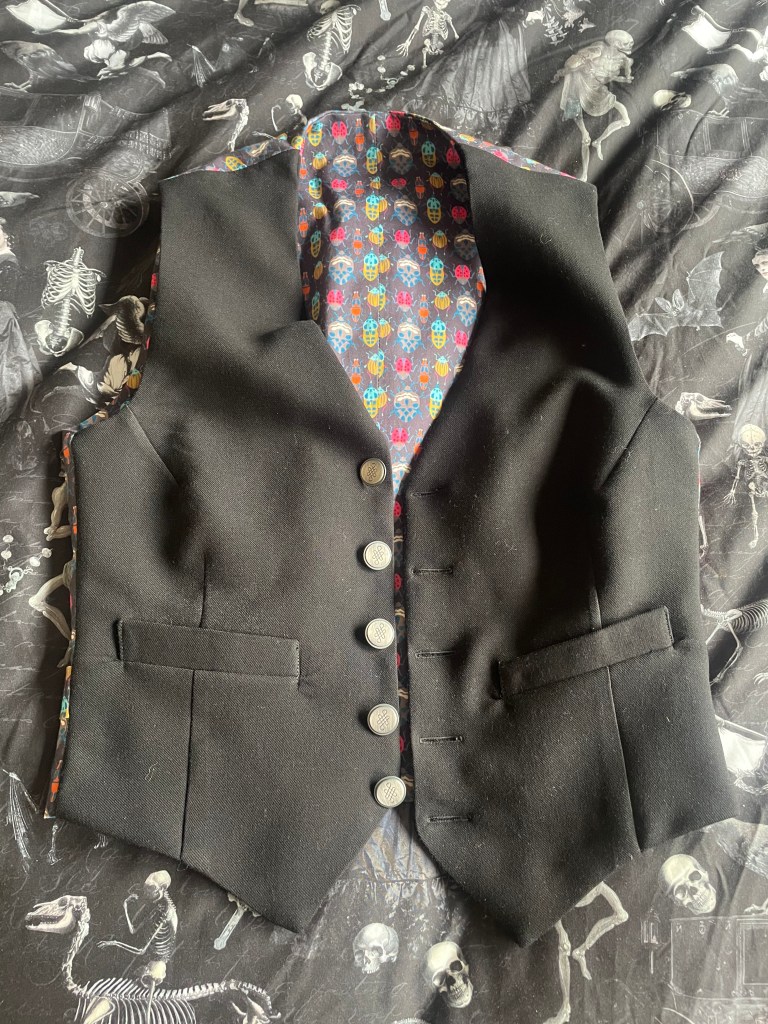
This will sound ridiculous (because it is) but my viva stole all the thunder from another accomplishment shared on the same day, my first self-made waistcoat that I wore on the day. I am so proud of how it turned out that I wish I had shown it off earlier as it faded into the background the moment I heard “congratulations Dr Niezynski”.
So maybe now we can all take a moment to admire it!
Follow me on Bluesky
@lniezynski.bsky.social

