On my quest to make an acceptable dent in my “TBR” (“to be read” for those peculiar creatures that have read all that they own) list, I finally made my way to Amphigorey: Fifteen books by Edward Gorey. All fifteen tales were magnificent however, it was the first, The Unstrung Harp, where I found myself reading a frighteningly familiar tale.
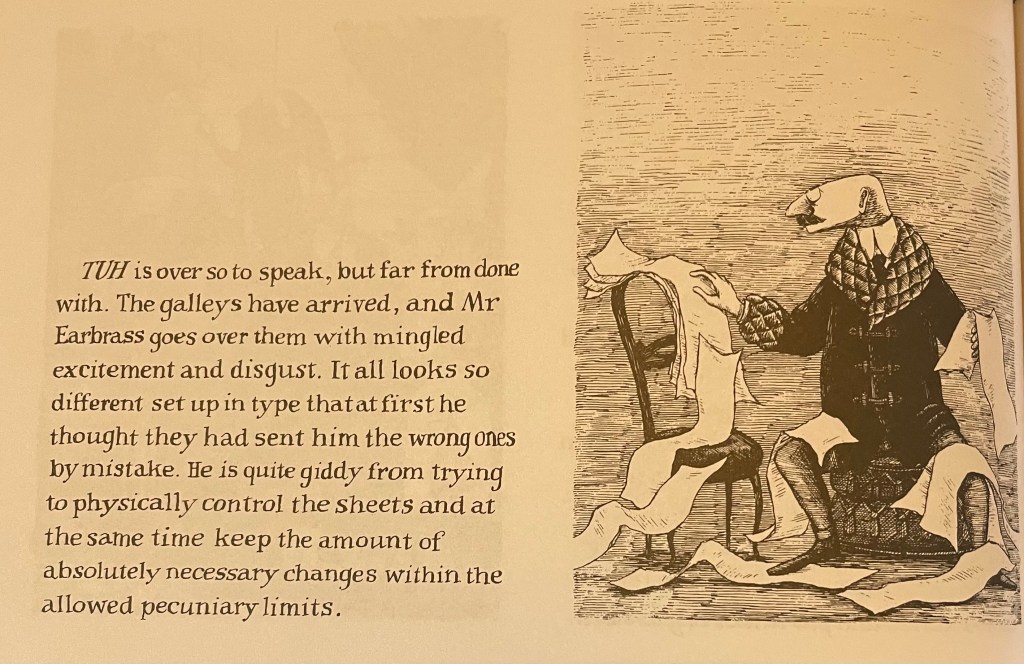
The story follows Mr Earbrass and the journey that is writing his next novel. As we move through we find Mr Earbrass sailing through and excitedly thinking up characters and plot lines to suddenly being hit with the notion that his work is terrible. In addition, we are presented with the woes of publisher edits, cover designs we hate but feel compelled to accept and the inevitable “numbing” acceptance of the fate poor Mr Earbrass finds himself in.
I accept there is an obvious overlap in the world of book (fiction and non-fiction) and academic publication writing however, the plight of Mr Earbrass felt horribly profound to me. This is process is exactly what writing papers feels like.
Recently I worked my way through my first paper. I felt I was onto to something great’ novel, unique, quirky yet “translatable” to academia. I enjoyed writing it and really got into it but there came a point where I started to fail to see or understand what I was doing. The paper had become a conflation of my idea with some contortion of an idea that I thought would be more palatable. Like Mr Earbrass, I thought some clever moving around and minor tweaks would be the solution but I swiftly learned this effort was in vain.
The paper was rejected (first rejection of my career, so now I am bona fide academic) and, like Mr Earbrass, went over the suggestions with excitement and disgust only to realise that I would never be able to keep the necessary changes to within the said pecuniary limits. And so, unlike Mr Earbrass, I cast it into the pile/chasm of “the forgotten works in progress”. While this sounds defeatist, part of me stands by the decision to part with the paper before reaching that level of numbness reflected by the dejected Mr Earbrass. If the feeling isn’t right, sometimes you just have to let it go.
Now my rejection was a few months ago but I am again in the process of developing papers. I am trying to find my feet as a writer and there is something wholly comforting about learning that these odd conflicting emotions are normal. At times there is a sense of writing being a love/hate relationship. I go from feeling strongly in my “forging my own path”/”this is going great” to “oh my God what am I even doing”/”this is awful no one will publish this” multiple times a week. There is a view that I need to find some peculiar balance between what I am as a writer/researcher and what is expected of me as a writer/researcher. However, I wonder if in fact this belief is what holds me back…
I have noted before that I am a huge admirer of Gorey. He developed his aesthetic/style (sinister cozy in case you are wondering) and he stuck by it. When his work was rejected, he saw this as an indicator that he had not yet found the right home for his creations and, if he could not find a home, he made his own; creating a publishing company to house it himself. On the other hand, when Gorey’s work was accepted, he embraced the opportunity it brought and flourished under the eyes of his fellow minds/weirdos (I mean “weirdos” as the highest possible compliment).
The Unstrung Harp and Mr Earbrass’s painful endeavour is thus perhaps a reminder of many important lessons. Here are a few I picked up, I expect there are many more and that they will come to me in time.
- Writing is not easy. Ever.
- There is a choice to follow your path to the end or to step off onto someone else’s path, it is your choice
- If you truly believe in something, stick with it, sometimes you just haven’t found the right home for your ideas yet
- Maybe controversial but: Sometimes the end goal is more important than the vision (i.e., do you need money/publications more than vision), and if it is then it might be best to “numb” yourself to avoid becoming too precious over your work
 Accounting for Humanity
Leave a comment