In a useful follow-up to my previous post concerning finding yourself at a conference that did not quite meet your needs, I can now present the opposite outcome. Over the last week I attend 2 further conferences and, thankfully, I can report that these experiences gifted me some very useful material and connections.
Conference 1: The First Annual Graduate Student Conference on Economic and Social History
This first outing is what I believe to be the absolute best kind of conference and the reason why you should periodically browse around to find events. I discovered this conference through my Economic History Society membership and, seeing that it was 1. local, 2. free, and 3. history related, I knew that I wanted to check it out. I confess I do not assess events like this for their relevance to my PhD before deciding to attend them, I love all things history so I am definitely going but in this instance, it did concern social and economic history thus, I was confident that I would be able to leave with some relevant insights for my own research.
Reflecting on the event I can certainly say that I was not disappointed. Firstly, being local (and a 1 day event) is a dream for my finances. I hopped on the bus to Edinburgh university for £2 and, after snacks, the whole day probably cost around £10. The location presented the added bonus of being able to explore the National museum during the break and wandering around in amazement at all of the nice cafes around Bristo Square.
For the conference content itself, every presentation was fascinating and more than a few sparked a lot of personal interest. Some of the content explored covered the mapping of historical furniture makers of Edinburgh (some very interesting possibilities here for future expansion of my thesis), Che Guevara & voluntary labour Human Capital & Philanthropy in 18thC Scotland, The British Left & Communist Poland, Protectionism & Pensions in Argentina, Zakat-the 3rd Pillar of Islam in tackling Poverty in Africa, Chinese Migration in Shanghai’s foreign settlements, Growth of small towns in 19thC England, Black & Black History Representation in Period Dramas (the inspired a lot of thought around “Historical Accuracy” and how removing black history from dramas actually creates the inaccuracy creators claim to be avoiding), and Poverty in 19thC England.
Hopefully I have not missed anything (I attempted to record the topic of each presentation) but if I did, I assure you it would most likely be due to my engrossment in the presentation and forgetting to take notes.
The conference organisers and one of the University Departments of my dreams (I wanted to be an Egyptologist and, to be honest, I’d still like to bring Egyptology into my research now that I have learned that interdisciplinary is a thing)
DCDC23: Discovering Collections, Discovering Communities Archival Conference @ Durham University
My next conference came not but 3 days after the first where, this time I hopped on a train to Durham for DCDC23 for 3 days. I admit I cannot fully recall how I discovered this conference, I suspect it was another periodic event hunt (I should do a separate post on this). Although it contained no reference to accounting, as I am utilising archival research for my thesis, this seemed like the best place to be to learn more about archives and meet some people from archival, museum and library backgrounds.
The conference began with its “History Day” exhibition, a set-up that saw various archives/libraries making themselves available for questions, promotion and all sorts of related magic. Now sadly, it felt like every archive was there except the one I intend to use (Bristol Archive), this is definitely an exaggeration as I am certain a vast number were not present but let us allow me this small flair of the dramatic this once. I did however, get the chance to talk to representatives from the UK National Archive who were very helpful and have given me much hope of finding additional content for my thesis.
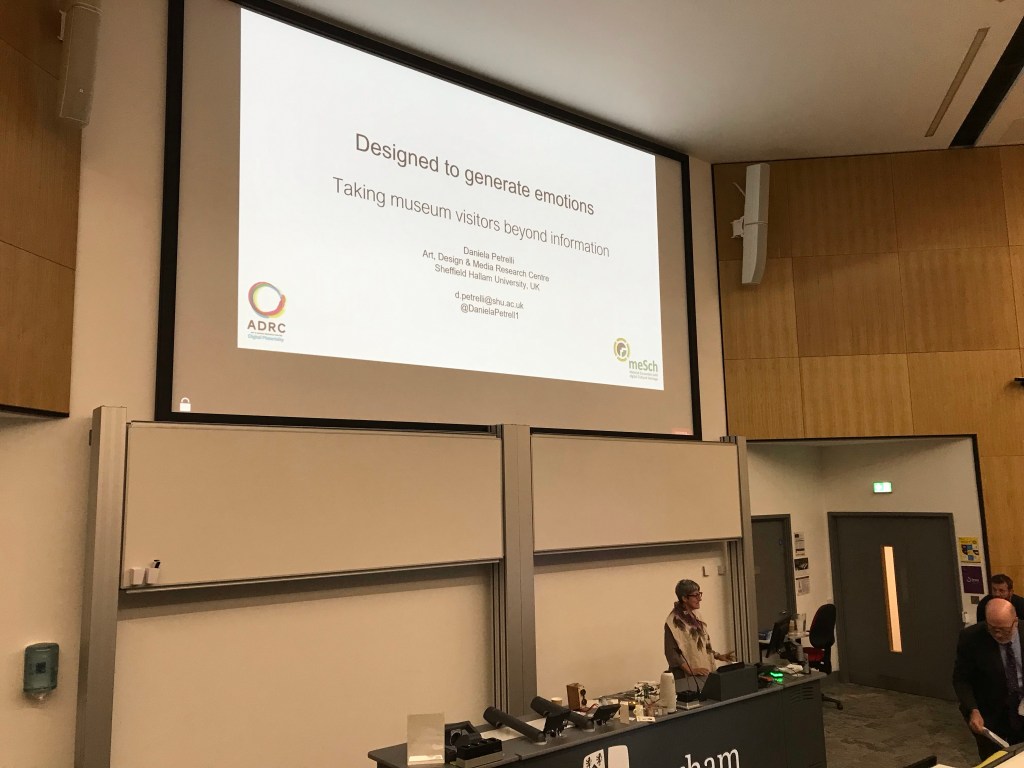
For the conference itself there were a mixture of keynotes, panels and workshops, all of which presented me with some very useful materials for thought and consideration. The point of the conference was not to introduce subject matter such as the previous conference but instead, to introduce me to ways that I can perform and present archival research. Thankfully I can report that I have been introduced to many avenues of exploration regarding how I might use and present my data visually in my research thus, we can call this conference a success.

The “Pebble”: an example of one of the numerous ways that technology is creating tools to encourage engagement with museum collections
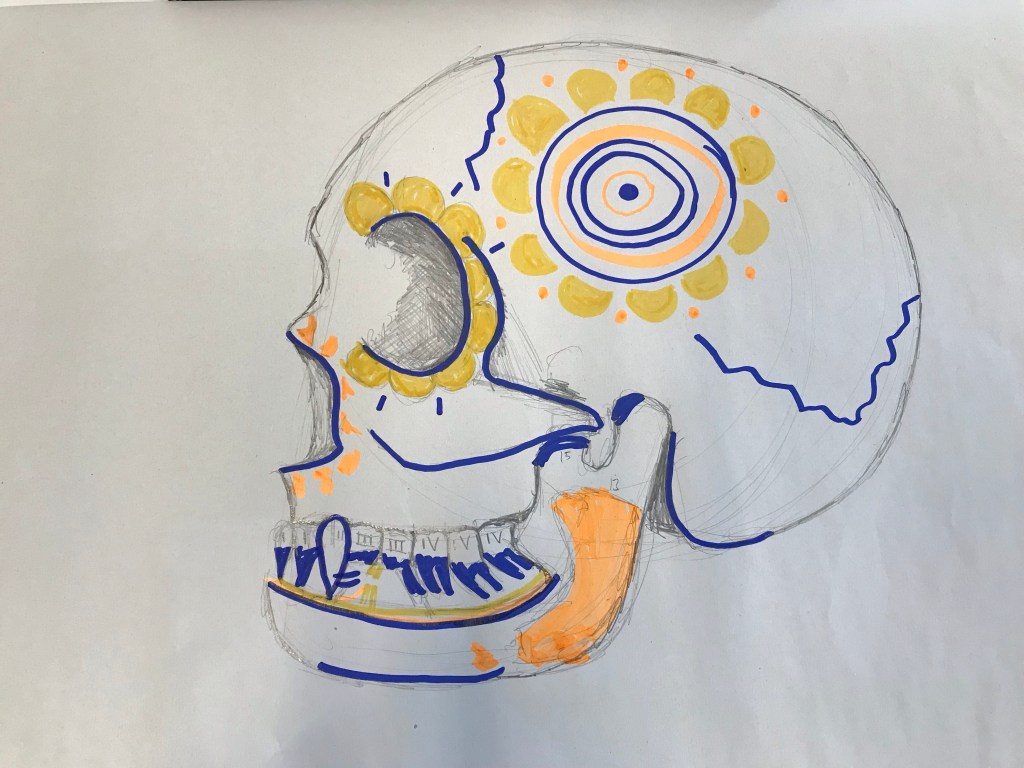
My drawing from one of the workshops, my idea was using anatomical models to teach both skeletal structure and about different death cultures (Mexican death practices in this case)
Let us now take a moment to share in frustration that I had finished typing this post but when adding in photos I somehow deleted the final 4 paragraphs… *screams*
Let’s try this again, Reflecting on the Conferences
This months conference outings both reiterate the learnings of the previous post and introduce some new points for consideration. The main lesson again is to choose your conferences wisely. These two conferences bore no relation to accounting research yet, they proved more valuable than the accounting conference that I attended last month. Thus, you really need to be clear on what you are doing in your own research and decide if an event includes aspects that would be beneficial to your specific needs/interests. Adding to this is the second lesson, and the reason for choosing wisely, conferences are expensive. Had I not attended the conference last month, my university expenses fund would not now be sitting fully depleted, I could have had the funds to attend next years BAFA conference for example but now, I will need to start saving to self-fund it.
For almost every conference there is a big financial commitment. There is the tickets, travel, accommodation and subsistence, none of which comes cheap. Further, while I have found the opportunity to explore new parts of the UK to be really enjoyable, I have a weakness for books and fancy snacks. The books may be cheap (second hand mostly) but, when you are buying them everywhere you go, that adds up (entirely my fault though, I could just not buy them).
There are ways to reduce costs (another future post perhaps) but still, a reasonable financial commitment is inevitable.
So what’s next?
As you may have guessed, I am going nowhere until my bank account recovers and my savings are restored. Thus, (and you should perhaps expect no less from an accounting PhD) the next few months will focus on super budget management.
As mentioned, I am doing archival research thus, funding will be needed to carry out Data Gathering expeditions to London and Bristol thus, I will be both saving and attempting to source and apply for funding (yet another future post).
In the meantime, my Bristol data does at least exist in digital transcribed form thus, for now it will be all data gathering and analysis. Expect lots of reading, writing, analysing, and pondering. Hopefully the next few posts can return to some research subject explorations. I did pick up a very interesting book in Durham (thank goodness I had a piggy bank full of £1 coins because I had to empty him to buy it) that will make for some very interesting research possibilities.
Until then, I leave you with 2 of the stupid things I bought in Durham…
Tea in one of those jam jar glasses, like I said fancy/silly snack weakness…
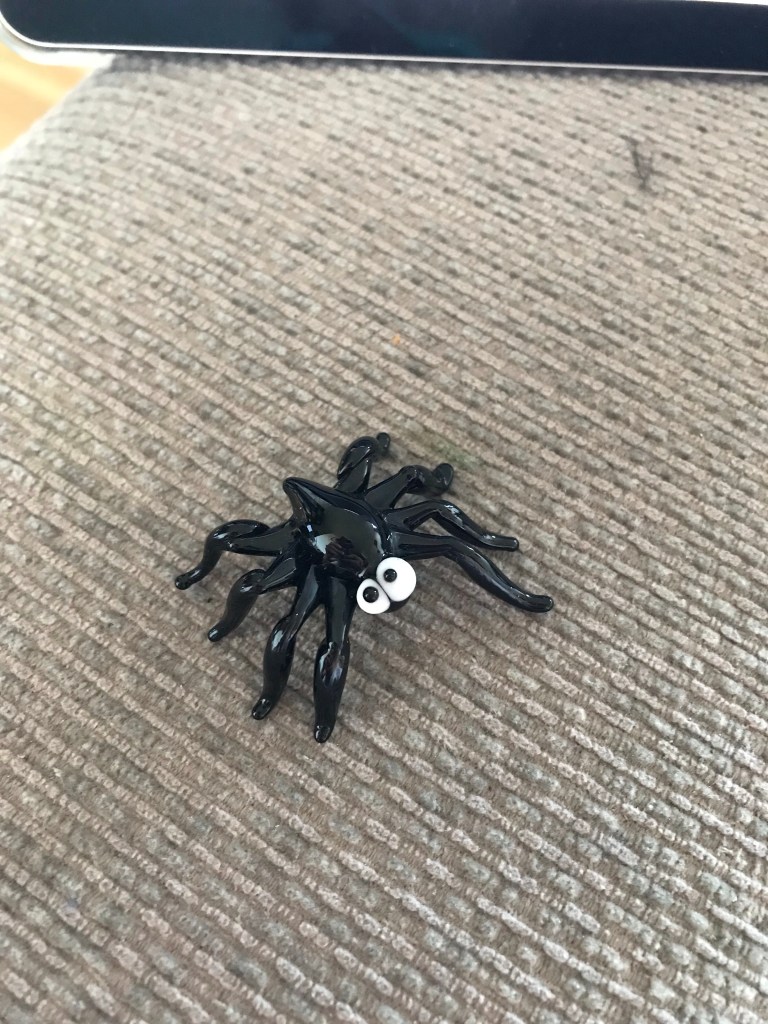
A glass spider, I have pet spiders (1 jumping spider, 1 tarantula) it felt necessary…
 Accounting for Humanity
Leave a comment