For myself, the inclusion of a historical perspective is an obvious choice when pursuing a research interest. From the age of 9, after being given the opportunity to mummify my cuddly rabbit as part of a school project on Ancient Egypt, I have fostered an ever-growing passion for history and its place and influence within our modern world.
Understandably however, PhD research requires a little more effort than the masterful crafting of the plasticine canopic jars that were to accompany my ‘Bunny Mummy’ to the afterlife (though such activity arguably required an equally high degree of skill and detail). One such expectation is to be able to provide justification for utilising an historical perspective. To explore history, one must show that there is a worthwhile reason to do so i.e., it must do more than evoke a romanticised vision of ‘days gone by’ or dreams of ‘simpler times’ (note: they were not ‘simpler’) in the reader.
While the goal to avoid what we shall term ‘nostalgia-bait’ is certainly desirable, the concept of having to justify history’s relevance feels most peculiar; history’s influence is everywhere and thus, its justification for inclusion feels obvious. Every thought, decision, interaction, encounter, event, and reflection has shaped who we are as individuals and further, who we are as societies and cultures. While no path is set in stone, to ignore the path already walked would render our lived experience somewhat incomplete, as knowing from where we have come can determine where we still must go; as George Santayana’s famous quote foretells:
“Those who cannot remember the past are condemned to repeat it.”
It could be countered that it is not the past, but the future that shaped our present, as our natural human ability to ‘think forward’ before acting can also influence our decisions (the perpetual “how will this affect A, B, and C?” dilemma). However, if we follow this viewpoint then, at the very least, it can then be argued that past and future bear equal relevance in the present as both have played an equal role in our development.
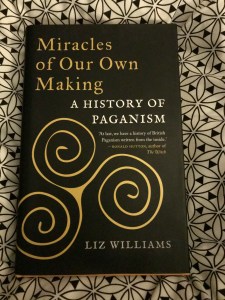
As mentioned, the influence of history is everywhere and as such, posts exploring the case for historical research will appear frequently here, or more accurately, as ‘evidence’ or ‘justification’ presents itself. The first such case stems from a recent reading: ‘The History of Paganism’ by Liz Williams. Before looking toward, the historical argument this book supports, there is a need to note that the influence of religion upon accounting and humanity is another strong interest, and undoubtably one for the list of ‘future research studies. Combining expertise from researchers such as Williams (2020) and renowned historian on Paganism, Ronald Hutton to explore the social connections between accounting and Britain’s ancient religions would be a fascinating realm of study (Hutton, 2014). Imagine the unique perspective and interest that such a connection could add to accounting and interdisciplinary research!
What makes Williams (2020) exploration of Britain’s ancient religions an excellent example of the relevance of historical research, is the journey taken to chart the growth of, not historical but modern paganism. Williams (2020) is not teaching us about ancient paganism, they are taking us through time to show us the ancestry of 21st century paganism. This approach places modernity in as the focus yet, we set that focus through walking backward through time. In utilising this historically based approach, Williams (2020) shows that although very little detail is known of ancient Britain, it can be seen that these lost religion’s ideals would come to influence and inspire future generations in developing their own modernised versions of paganism.
By mapping a timeline from 10,000+BCE to present day, there is a family tree laid out before us that traces the origin of 21st century paganism. The keynote here is that this a familial relationship thus, this suggests that we are not looking at the same entity but instead we are viewing generational entities that have ‘inherited’ the characteristics of their ancestors. This can be evidenced with Williams (2020) in recognising the familiar, but not historically confirmed, concepts embodied by ancient paganism’s modern ‘offspring’ such as Freemasonry, the Order of the Golden Dawn, Wicca, and modern Heathenry and Druidry.
Although as noted, the ancient and the modern iterations are not the same religion however, it can be argued that these modernised religions would not have been possible without their historical and ancient predecessors. Each generation embodied the perceived ideals of the previous iteration to build a religion that could attain a similar theosophical/religious objective within their own current societal contexts thus, creating these new alternate religions. It could also be countered that, in the absence of the previous versions of paganism, other influences could have led to the development of similar groups as Williams (2020) noted that some modern groups were politically motivated however, this would still support an implication that its development spawned from a form of historically-based social or human influence.
In terms of what this book can show us in relation to explaining why history is important in research. To invoke a metaphor, History is the foundation of society and humanity. It is true that a building does not stand through foundations alone, it needs structure; bones to make it strong, and skin to protect the precious content within. Thus, while there are many aspects needed to make solid research, without our historical foundations, our research may simply sink into the sands of time…
References:
Hutton, R. (2014) Pagan Britian London: Yale Univesity Press.
Williams, L. (2020) Miracles of Our Own Making: A History of Paganism in the British Isles. London: Reaktion Books.
 Accounting for Humanity
Leave a comment